
Highest Rated Events (only 193 and 304 shown) All AR FE FL

Rating:
4.0 (0=lowest, 5=highest)
Num Ratings:1
Detected by halocme, Submitted at 2017-09-14T08:05:57
2017-09-12T07:15:01 --> 2017-09-12T08:05:25
The flare occurred in AR 12680. The wave was driven mostly southward.


Rating:
4.0 (0=lowest, 5=highest)
Num Ratings:1
Detected by halocme, Submitted at 2017-09-14T07:59:55
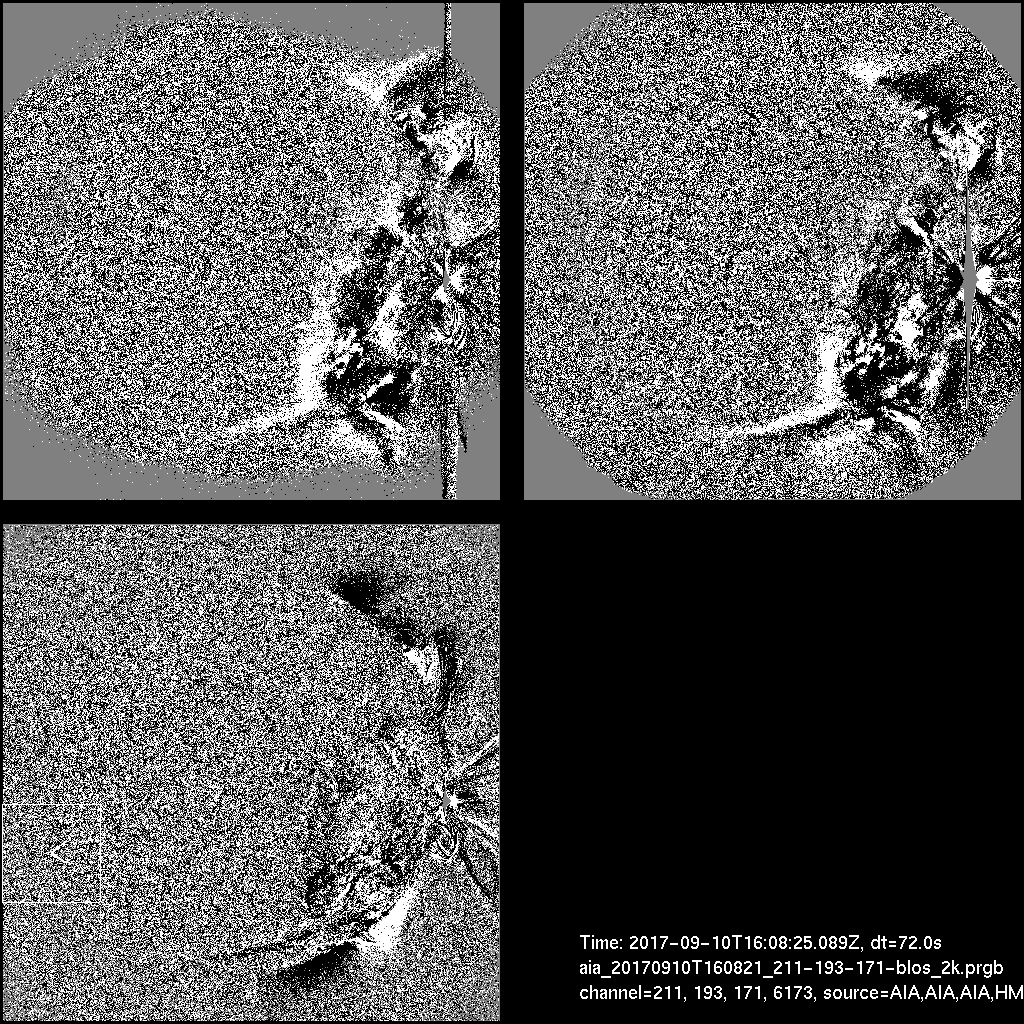
2017-09-10T15:30:01 --> 2017-09-10T16:50:25
The flare was probably stronger than X8.2 because AR 12673 was slightly behind the limb. The coronal wave appeared to be the widest, covering the entire surface. The associated CME was super fast (3000-3500 km/s), and resulting in quick onset of a big SEP event, possibly a GLE.

Rating:
4.0 (0=lowest, 5=highest)
Num Ratings:1
Detected by halocme, Submitted at 2017-09-14T07:08:16
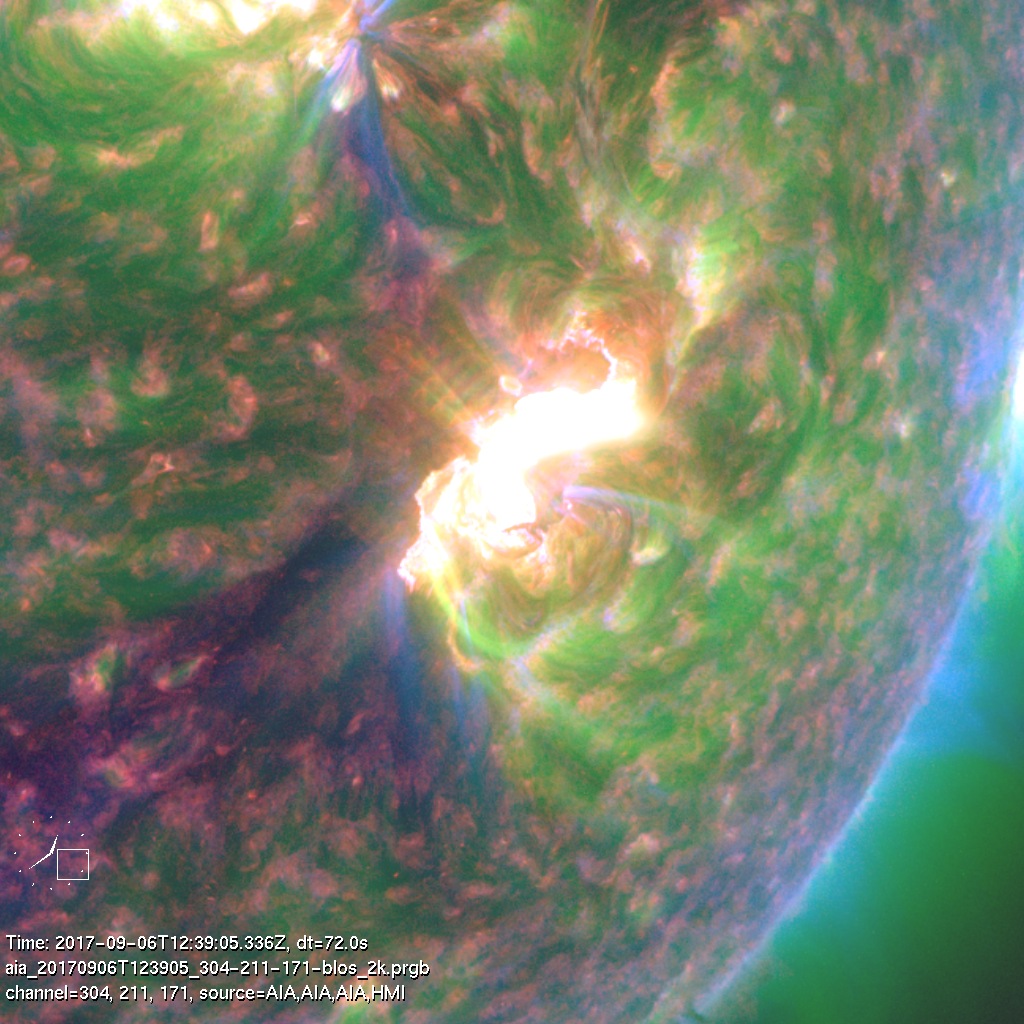
2017-09-06T11:40:17 --> 2017-09-06T13:29:29
This is the largest flare in solar cycle 24. The last flare with a similar magnitude (X9.0) occurred on 5 December 2006. It occurred impulsively in AR 12673, producing global waves. The associated halo CME is fast (maybe too fast to be measured in http://spaceweather.gmu.edu/seeds/mkmovie.php?cme=20170906.122407.w155.v0582.p243&frame=7&r).
Rating:
4.0 (0=lowest, 5=highest)
Num Ratings:1
Detected by halocme, Submitted at 2017-09-14T07:08:15
2017-09-06T11:40:17 --> 2017-09-06T13:29:29
This is the largest flare in solar cycle 24. The last flare with a similar magnitude (X9.0) occurred on 5 December 2006. It occurred impulsively in AR 12673, producing global waves. The associated halo CME is fast (maybe too fast to be measured in http://spaceweather.gmu.edu/seeds/mkmovie.php?cme=20170906.122407.w155.v0582.p243&frame=7&r).
Rating:
4.0 (0=lowest, 5=highest)
Num Ratings:1
Detected by gchintzo, Submitted at 2017-07-22T01:08:15
2017-07-13T00:00:09 --> 2017-07-14T06:10:09
The source region of a moderately fast CME (projected to the plane of the sky speed of 556 km/sec; http://spaceweather.gmu.edu/seeds/mkmovie_ql.php?cme=20170714.013612.w109.v0556.p251&frame=5). Note the interesting "rapture" of connectivity with smaller AR 12666.


Rating:
4.0 (0=lowest, 5=highest)
Num Ratings:1
Detected by gchintzo, Submitted at 2017-07-22T00:50:08
2017-07-06T01:40:09 --> 2017-07-08T02:30:09
A filament (dark feature) is progressively lifting up, until its eruption is switched off. Material flowing after the failed eruption shows longer connectivities of this magnetic structure towards the West. At the end of the movie, the filament is seen to osciallate along the North/South direction.

Rating:
4.0 (0=lowest, 5=highest)
Num Ratings:1
Detected by jinmeng, Submitted at 2017-07-18T18:43:57
2017-07-14T00:00:09 --> 2017-07-14T04:24:09
A more clear view of the sympathetic eruption in the running difference movie. The second eruption near the west limb started right after the disturbance of the first eruption arrived.

Rating:
4.0 (0=lowest, 5=highest)
Num Ratings:1
Detected by jinmeng, Submitted at 2017-07-18T18:40:09
2017-07-14T00:00:09 --> 2017-07-14T04:24:09
Sympathetic eruptions observed in the west hemisphere. The eruption from AR 12665 seems to cause another eruption near the west limb.

Rating:
4.0 (0=lowest, 5=highest)
Num Ratings:1
Detected by halocme, Submitted at 2017-07-06T02:06:24
2017-07-03T15:30:01 --> 2017-07-03T18:00:01
I forgot to mention in the last annotation that the M1.3 flare (newly emerged non-numbered region) was not homologous to the B1.3 flare (AR 12644). This wave is slightly more pronounced in the clockwise direction.

Rating:
4.0 (0=lowest, 5=highest)
Num Ratings:1
Detected by halocme, Submitted at 2017-07-06T00:58:31
2017-07-02T11:50:25 --> 2017-07-02T14:20:25
These running difference images reveal the coronal wave more clearly. It is also easier to find the erupting filament. The wave is more pronounced in the counterclockwise direction. It seems to produce a secondary wave as it propagates into large-scale structures.

Rating:
4.0 (0=lowest, 5=highest)
Num Ratings:1
Detected by jinmeng, Submitted at 2017-06-06T21:17:24
2017-06-01T11:36:09 --> 2017-06-01T13:25:09
The running difference movie of the two-stage limb eruption, in which the coronal cavity is evident after first stage. The cavity might indicate the existence of the coronal flux rope.


Rating:
4.0 (0=lowest, 5=highest)
Num Ratings:1
Detected by jinmeng, Submitted at 2017-06-06T21:07:25
2017-06-01T11:36:09 --> 2017-06-01T13:45:09
An eruption from the same active region at the east limb. The eruption seems to have two stages. In the first stage, the eruption caused coronal changes and formed a quasi-stable structure (possibly flux rope). The "flux rope" erupted short after it reached certain height.

Rating:
4.0 (0=lowest, 5=highest)
Num Ratings:1
Detected by jinmeng, Submitted at 2017-06-06T21:07:25
2017-06-01T11:36:09 --> 2017-06-01T13:45:09
An eruption from the same active region at the east limb. The eruption seems to have two stages. In the first stage, the eruption caused coronal changes and formed a quasi-stable structure (possibly flux rope). The "flux rope" erupted short after it reached certain height.
Rating:
4.0 (0=lowest, 5=highest)
Num Ratings:1
Detected by jinmeng, Submitted at 2017-06-06T18:49:16
2017-06-01T01:37:33 --> 2017-06-01T02:22:21
EUV waves associated with a limb eruption.

Rating:
4.0 (0=lowest, 5=highest)
Num Ratings:1
Detected by jinmeng, Submitted at 2017-06-06T18:44:39
2017-06-01T01:31:09 --> 2017-06-01T02:22:21
A nice eruption was observed at the east limb. This eruption also generated EUV waves.

Rating:
4.0 (0=lowest, 5=highest)
Num Ratings:1
Detected by jinmeng, Submitted at 2017-05-31T00:49:04
2017-05-26T03:06:09 --> 2017-05-26T05:56:09
Synchronous filament eruptions were observed near the west limb. One filament is from an active region and the other one is from quiet Sun. The two filaments started to rise at the same time, which might indicate the magnetic connectivity between the two locations.

Rating:
4.0 (0=lowest, 5=highest)
Num Ratings:1
Detected by jinmeng, Submitted at 2017-05-27T02:28:50
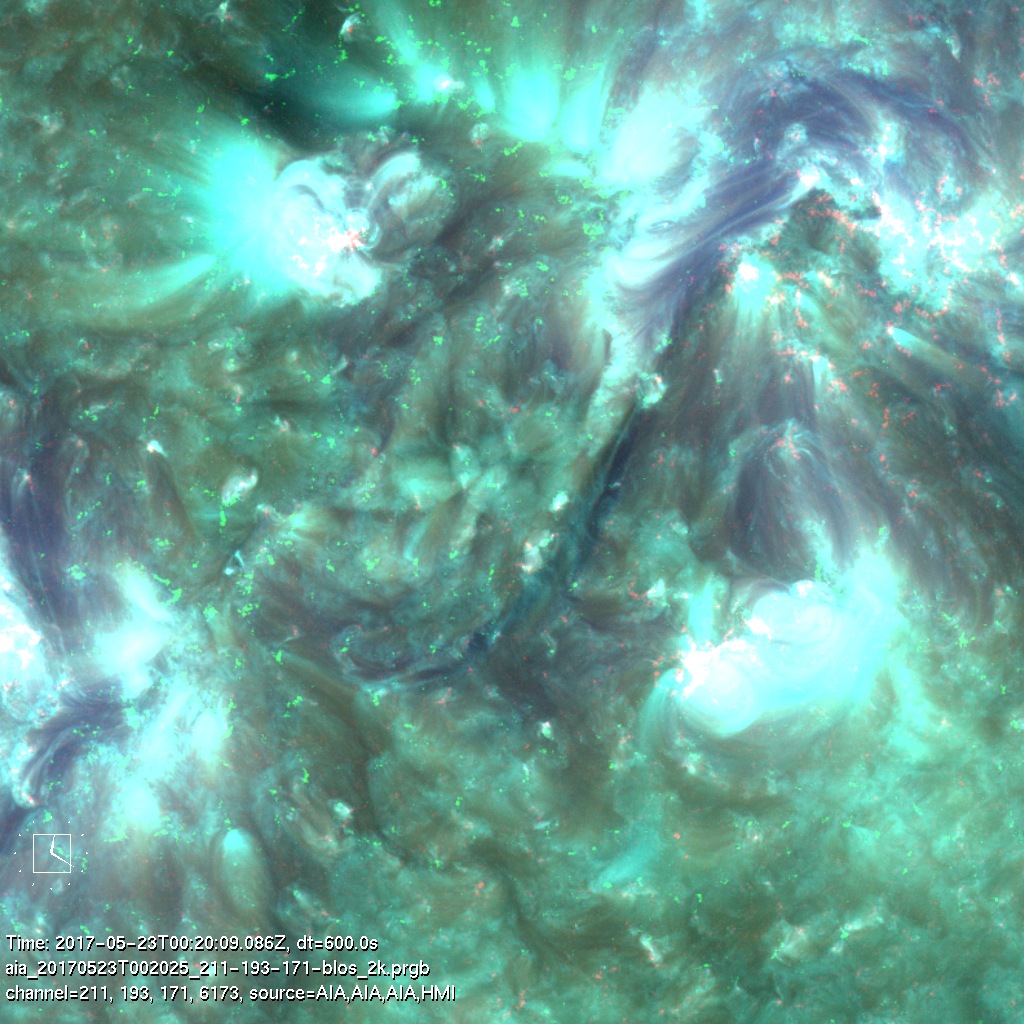
2017-05-22T04:40:09 --> 2017-05-23T13:20:09
Not a typical sympathetic filament eruption. The first filament did not erupt but most of its material went back to the Sun. This process made another filament unstable and finally erupt.

Rating:
4.0 (0=lowest, 5=highest)
Num Ratings:1
Detected by halocme, Submitted at 2017-05-07T00:45:03
2017-05-01T03:45:01 --> 2017-05-01T05:45:01
This eruption came from the same region as the jet on 30 April 2017 18:30 as reported earlier. It now involved ejection of cool material, most of which seemed to fall back. It was associated with a short-duration B9.9 flare.

Rating:
4.0 (0=lowest, 5=highest)
Num Ratings:1
Detected by halocme, Submitted at 2017-05-06T20:05:56
2017-04-29T22:40:13 --> 2017-04-30T05:00:13
The eruption started slowly in AR 12653 (without a clear filament as a marker) but produced significant coronal dimming on both sides of the flare ribbons. Post eruption arcades were formed, explaining the associated B3.0 long-decay event in soft X-rays. This eruption did not arrive at Earth.

Rating:
4.0 (0=lowest, 5=highest)
Num Ratings:1
Detected by halocme, Submitted at 2017-05-06T19:48:16
2017-04-28T14:00:09 --> 2017-04-28T17:30:09
The eruption nicely shows helical motions that may indicate a flux rope. Some citizen scientists said that this was a breakout eruption, but it does not look that way. Reconnection signatures expected before and during the main eruption are weak. This may be more consistent with kink- or torus-unstable eruption. The eruption in the radial direction was obviously not smooth with disturbances slowly moving horizontally, especially counterclockwise. This is consistent with disappointingly small presence of the consequence of the eruption in LASCO data.
