
Highest Rated Events (only 193 and 304 shown) All AR FE FL

Rating:
3.0 (0=lowest, 5=highest)
Num Ratings:1
Detected by halocme, Submitted at 2017-02-27T06:34:48
2017-02-20T14:00:09 --> 2017-02-20T20:00:09
This eruption seemed to involve a wide longitude just behind the limb on the basis of the EUVI-A images. It resulted in a narrow CME as in http://spaceweather.gmu.edu/seeds/mkmovie.php?cme=20170220.182407.w025.v0179.p058&frame=22&r.

Rating:
3.0 (0=lowest, 5=highest)
Num Ratings:1
Detected by gchintzo, Submitted at 2017-02-20T23:11:08
2017-02-18T17:40:09 --> 2017-02-20T00:40:09
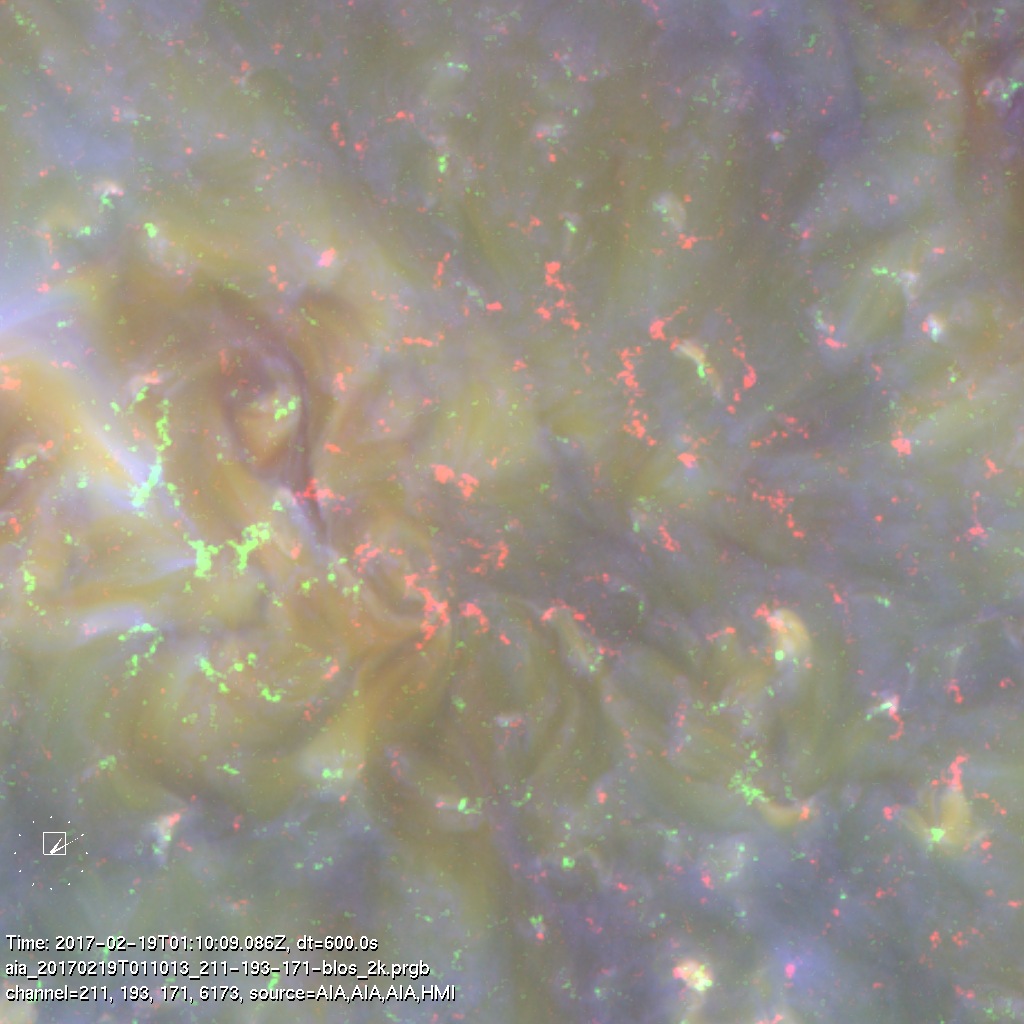
A hook-shaped filament formed above a decaying Active Region (red: negative, green: positive line-of-sight magnetic field saturated at |B|=250 G). This eruption does not seem to be associated with a CME (based on LASCO observations). The brief darkening of the movie occurs due to SDO's eclipse season (FOV occulted by Earth).

Rating:
3.0 (0=lowest, 5=highest)
Num Ratings:1
Detected by gchintzo, Submitted at 2017-02-20T22:59:27
2017-02-17T17:40:09 --> 2017-02-18T17:00:09
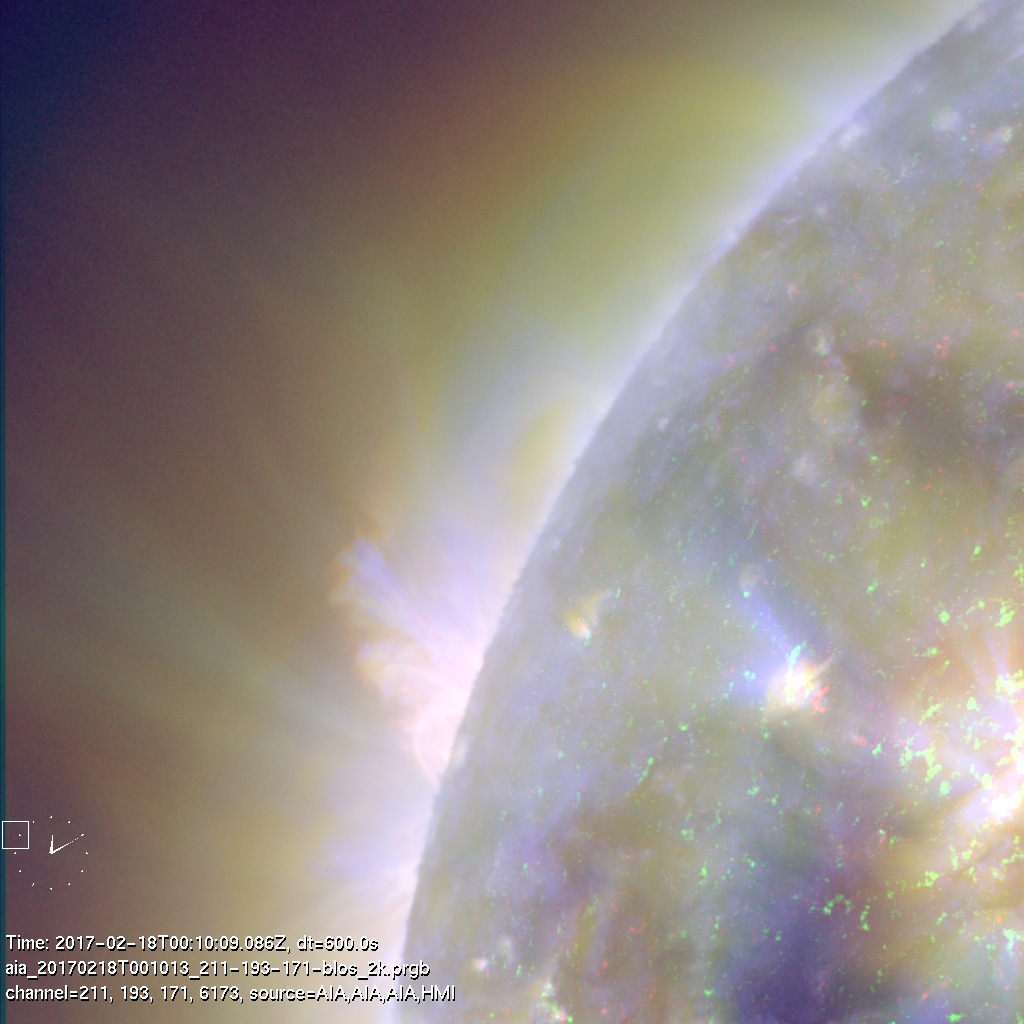
Tri-color movie (red: 211 A, green: 193 A, blue: 171 A) centered at the North East solar limb showing a narrow angle eruption in different wavelengths. This eruption is the source of a slow (200 km / sec) narrow-angle (jet-like) CME observed by LASCO (see http://spaceweather.gmu.edu/seeds/mkmovie.php?cme=20170218.012522.w032.v0168.p063&frame=16&r) The Eruption occurs a few hours after another jet-like CME eruption from the same source region. The CME quickly overtakes the prior eruption.
Rating:
3.0 (0=lowest, 5=highest)
Num Ratings:1
Detected by gchintzo, Submitted at 2017-02-20T22:22:17
2017-02-17T07:00:09 --> 2017-02-17T20:00:09
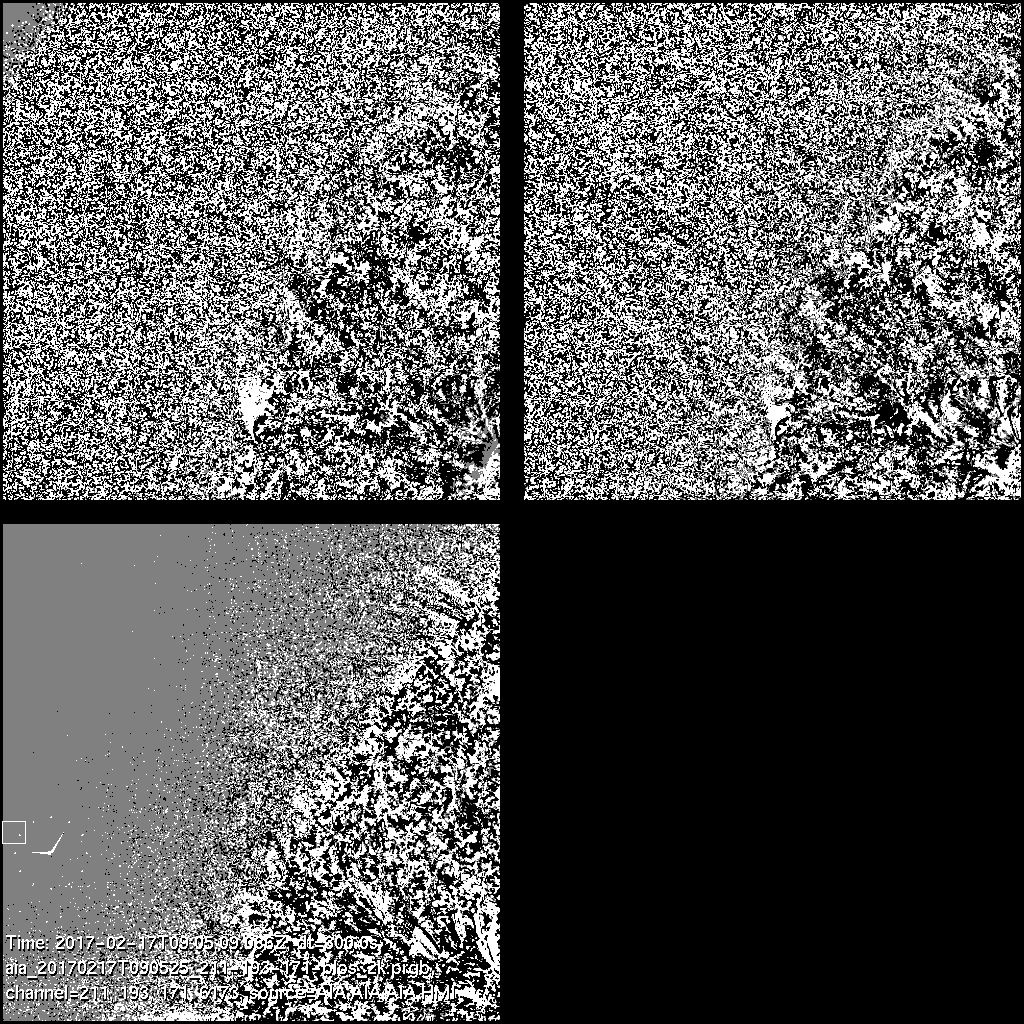
Running difference movie showing the North East solar limb showing a narrow angle eruption in different wavelengths. This eruption is the source of a slow (200 km / sec) narrow-angle (jet-like) CME observed by LASCO (see http://spaceweather.gmu.edu/seeds/mkmovie.php?cme=20170217.152409.w023.v0205.p059&frame=18&r)

Rating:
3.0 (0=lowest, 5=highest)
Num Ratings:1
Detected by gchintzo, Submitted at 2017-02-14T00:27:06
2017-02-12T12:00:09 --> 2017-02-13T16:00:09
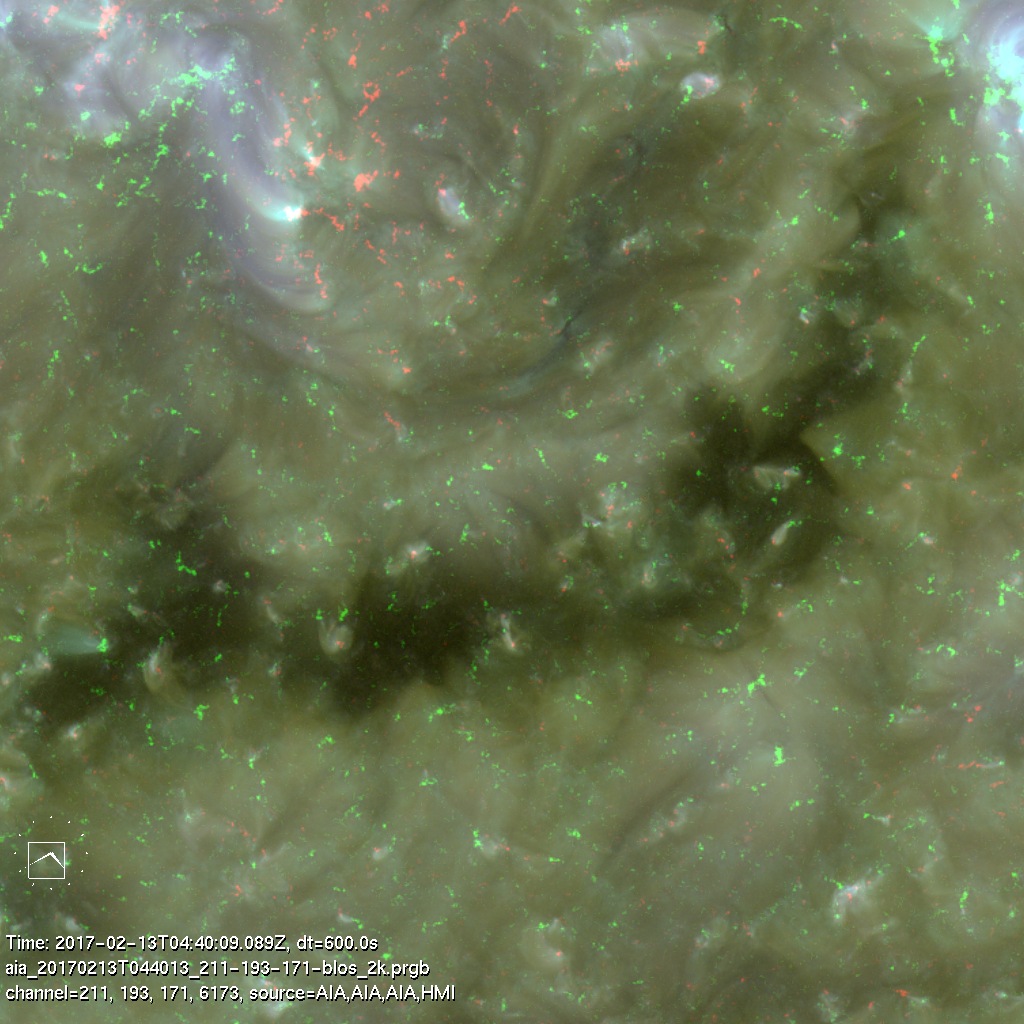
A narrow, trans-equatorial coronal hole. Coronal holes are predominantly unipolar regions (here, green positive magnetic field, red negative magnetic field). Note the significant amount of activity within the coronal hole, primarily at locations where 'parasitic' negative patches exist (red color). Each negative patch seems to be connected to a nearby positive patch; several of these ad-hoc bipoles seem to host mini-sigmoids in the corona, which some of those mini-sigmoids erupt/interact with neighboring ones.

Rating:
3.0 (0=lowest, 5=highest)
Num Ratings:1
Detected by gchintzo, Submitted at 2017-02-14T00:17:10
2017-02-11T00:00:09 --> 2017-02-11T23:50:09
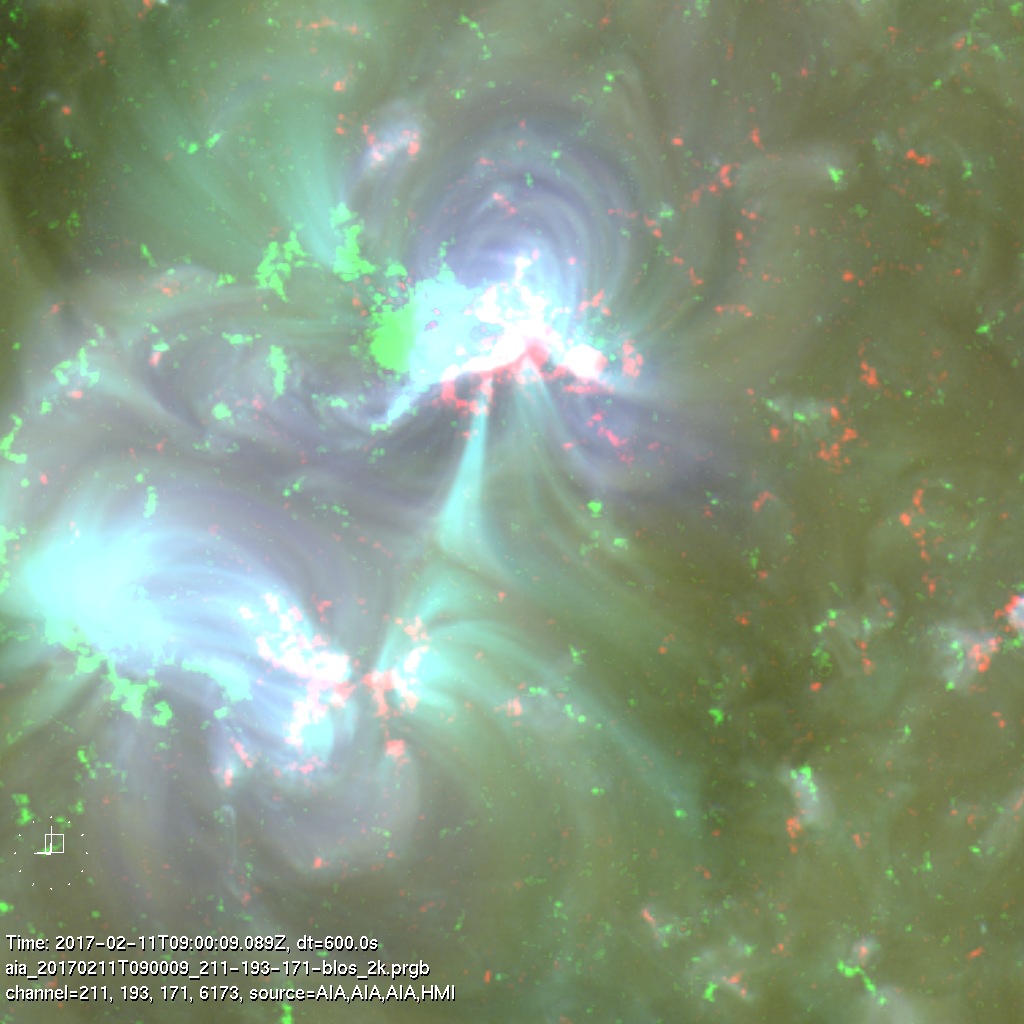
A pair of North Hemisphere Active Regions (ARs) in close proximity. The ARs have their polarity orientation almost in parallel. Interesting connectivity arises in the corona - especially an "X-point"-like configuration of fieldilnes.
Rating:
3.0 (0=lowest, 5=highest)
Num Ratings:1
Detected by halocme, Submitted at 2017-02-12T00:29:01
2017-02-10T07:00:09 --> 2017-02-10T12:00:09
A very minor eruption. Not clear how high the filament reached.

Rating:
3.0 (0=lowest, 5=highest)
Num Ratings:1
Detected by halocme, Submitted at 2017-02-10T06:22:23
2017-02-10T02:30:01 --> 2017-02-10T03:00:01
A small filament erupted showing rotation (in 171 A), and disturbed the overlying corona to oscillate. Part of the corona stayed dimmed for 30-40 minutes (but no obvious CME).


Rating:
3.0 (0=lowest, 5=highest)
Num Ratings:1
Detected by halocme, Submitted at 2017-02-09T19:19:39
2017-02-07T16:00:09 --> 2017-02-07T20:00:09
Curious about what AIA saw while IRIS recorded "Small hot loops (Other)". In an extended field of view and temporal range, we indeed see a microflare + jet (17:55-18:10), which would be easily overlooked while hunting for big eruptions.

Rating:
3.0 (0=lowest, 5=highest)
Num Ratings:1
Detected by halocme, Submitted at 2017-02-09T18:16:48
2017-02-08T15:30:01 --> 2017-02-08T16:30:01
A small filament erupted from a quiescent region. Interestingly, the eruption was nearly cosincident with the earuption from behind the northwest limb. This was perhaps by chance.

Rating:
3.0 (0=lowest, 5=highest)
Num Ratings:1
Detected by halocme, Submitted at 2017-02-09T18:08:55
2017-02-08T15:30:01 --> 2017-02-08T16:30:01
This must have been from the backside since no eruptive signatures were noted on the visible side. A narrow CME was associated with this eruption. See the SEEDS CME catalog at http://spaceweather.gmu.edu/seeds/mkmovie.php?cme=20170208.161208.w042.v0328.p297&frame=16&r.

Rating:
3.0 (0=lowest, 5=highest)
Num Ratings:1
Detected by halocme, Submitted at 2017-02-08T07:59:11
2017-02-07T11:00:09 --> 2017-02-07T12:50:09
This occurred in the northern part of AR 12632, separate from but maybe affected by the earlier eruption in the southern part. The LASCO movie http://spaceweather.gmu.edu/seeds/mkmovie.php?cme=20170207.100007.w035.v0346.p292&frame=13&r contains both eruptions.

Rating:
3.0 (0=lowest, 5=highest)
Num Ratings:1
Detected by halocme, Submitted at 2017-02-08T07:40:31
2017-02-07T07:40:13 --> 2017-02-07T10:40:13
This eruption started with tumbling motions of low-lying prominences. LASCO data do not clearly reveal a flux rope in the outflow (see http://spaceweather.gmu.edu/seeds/mkmovie.php?cme=20170207.100007.w035.v0346.p292&frame=13&r), but it looks more like a CME than earlier events on Feb 5.


Rating:
3.0 (0=lowest, 5=highest)
Num Ratings:1
Detected by halocme, Submitted at 2017-02-08T07:40:31
2017-02-07T07:40:13 --> 2017-02-07T10:40:13
This eruption started with tumbling motions of low-lying prominences. LASCO data do not clearly reveal a flux rope in the outflow (see http://spaceweather.gmu.edu/seeds/mkmovie.php?cme=20170207.100007.w035.v0346.p292&frame=13&r), but it looks more like a CME than earlier events on Feb 5.
Rating:
3.0 (0=lowest, 5=highest)
Num Ratings:1
Detected by halocme, Submitted at 2017-02-08T07:29:29
2017-02-06T04:00:09 --> 2017-02-06T05:00:09
The footpoint brightening occurred nearly simultaneously with an ejeciton that looked like a jet. Quick-look at the photospheric magnetograms indicates that the footpoint corresponds to cancellation rather than emergence.

Rating:
3.0 (0=lowest, 5=highest)
Num Ratings:1
Detected by halocme, Submitted at 2017-02-08T07:15:36
2017-02-06T01:00:09 --> 2017-02-06T02:30:09
It is hard to find what triggered this (perhaps just as a result of active region evolution), but the corona above AR 12632 gradually dimmed, perhaps representing a small and slow eruption.

Rating:
3.0 (0=lowest, 5=highest)
Num Ratings:1
Detected by halocme, Submitted at 2017-02-08T07:06:14
2017-02-05T17:00:09 --> 2017-02-05T19:00:09
A filament is moving toward northwest. If this is an eruption, it is highly non-radial. But the motions are seen only in 304 A channel, and it is possible that nothing erupted.

Rating:
3.0 (0=lowest, 5=highest)
Num Ratings:1
Detected by halocme, Submitted at 2017-02-08T06:56:32
2017-02-05T06:45:01 --> 2017-02-05T08:10:13
Similar to the earlier event around 01 UT. Marginal LASCO presence.

Rating:
3.0 (0=lowest, 5=highest)
Num Ratings:1
Detected by halocme, Submitted at 2017-02-08T06:50:12
2017-02-05T00:15:01 --> 2017-02-05T01:15:01
This was probably from a region slightly behind the west limb. It was non-radial toward the equator and seen most prominently in 304 A images. The associated CME was also narrow (see http://spaceweather.gmu.edu/seeds/mkmovie.php?cme=20170205.012545.w006.v0293.p299&frame=3&r).

Rating:
3.0 (0=lowest, 5=highest)
Num Ratings:1
Detected by gchintzo, Submitted at 2017-02-03T23:57:12
2017-02-03T04:10:09 --> 2017-02-03T20:40:09
The onset of a jet-like (narrow angle) CME eruption. Before the onset, some background loops are seen to retract towards the North (North is up). The associated CME was of slow-to-intermediate speed (~450 km sec; see http://spaceweather.gmu.edu/seeds/mkmovie.php?cme=20170203.182407.w018.v0460.p306&frame=11&r)
