Highest Rated Events (only 193 and 304 shown) All AR FE FL

Rating:
3.0 (0=lowest, 5=highest)
Num Ratings:1
Detected by halocme, Submitted at 2019-04-29T22:50:14
2019-04-21T03:15:01 --> 2019-04-21T04:00:37
Like the previous two cases, the eruption was more lateral than radial. This one shows both the driver and front. Also note the clockwise rolling motions in the driver.


Rating:
3.0 (0=lowest, 5=highest)
Num Ratings:1
Detected by halocme, Submitted at 2019-04-29T22:42:59
2019-04-20T22:20:25 --> 2019-04-20T23:20:25
This looks homologous to the previous event around 20 April 2019 09:30. The propagating front is weaker. Instead, the driver is revealed in more detail, involving low-lying structures tumbling in the wake of the wave passing.

Rating:
3.0 (0=lowest, 5=highest)
Num Ratings:1
Detected by halocme, Submitted at 2019-04-29T22:42:59
2019-04-20T22:20:25 --> 2019-04-20T23:20:25
This looks homologous to the previous event around 20 April 2019 09:30. The propagating front is weaker. Instead, the driver is revealed in more detail, involving low-lying structures tumbling in the wake of the wave passing.
Rating:
3.0 (0=lowest, 5=highest)
Num Ratings:1
Detected by halocme, Submitted at 2019-04-29T22:33:38
2019-04-20T09:15:01 --> 2019-04-20T10:49:49
An eruption in AR 12738 mostly southward produced an EUV wave we had not seen for a while. The eruption was more strongly lateral (southward) than radial. The CME that resulted from the eruption was slow and weak (http://spaceweather.gmu.edu/seeds/mkmovie_ql.php?cme=20190420.100007.w016.v0269.p284&frame=7).

Rating:
3.0 (0=lowest, 5=highest)
Num Ratings:1
Detected by halocme, Submitted at 2019-04-29T22:23:59
2019-04-19T23:30:01 --> 2019-04-20T01:30:01
This may look similar to the previous examples of jets from the northwestern part of AR 12728, but this one was apparently on a larger scale since it was produced a CME (http://spaceweather.gmu.edu/seeds/mkmovie_ql.php?cme=20190420.012540.w065.v0314.p270&frame=12). Higher up, the eruption was deflected to south,


Rating:
3.0 (0=lowest, 5=highest)
Num Ratings:1
Detected by halocme, Submitted at 2019-04-29T22:16:11
2019-04-19T05:50:25 --> 2019-04-19T06:45:37
Another example of jets from the northwestern part of AR 12738.

Rating:
3.0 (0=lowest, 5=highest)
Num Ratings:1
Detected by halocme, Submitted at 2019-04-29T00:03:12
2019-04-18T10:30:01 --> 2019-04-18T11:15:37
The northwestern part og AR 12738 also abounded in narrow outflows. These may be jets but look also like blobs that may represent plasmoids.

Rating:
3.0 (0=lowest, 5=highest)
Num Ratings:1
Detected by halocme, Submitted at 2019-04-28T23:54:10
2019-04-17T21:55:13 --> 2019-04-18T00:50:25
This is another example of a jet period seen at the southwestern part of the sunspot of AR 12738

Rating:
3.0 (0=lowest, 5=highest)
Num Ratings:1
Detected by halocme, Submitted at 2019-04-28T23:46:57
2019-04-17T08:15:01 --> 2019-04-17T08:59:25
The jet southward was seen multiple times from the western part of the big spot of AR 12738, probably reflecting long-lived coronal structures incluidng open field lines.

Rating:
3.0 (0=lowest, 5=highest)
Num Ratings:1
Detected by halocme, Submitted at 2019-04-04T22:22:26
2016-08-12T18:10:10 --> 2016-08-12T19:10:10
This eruption from the backside (probably from AR 12572, then around W110 or so) resulted in a slow but extended CME (http://cdaw.gsfc.nasa.gov/images/soho/lasco_ql/2016/08/12/20160812_202406_lasc2rdf_ql.png). The large-scale eruption in the low corona is brought out only in difference images. The contemporaneous B2.8 flare was from a disk region (AR 12576) and unrelated with this eruption.

Rating:
3.0 (0=lowest, 5=highest)
Num Ratings:1
Detected by gchintzo, Submitted at 2019-04-04T00:47:16
2019-03-30T00:00:09 --> 2019-04-03T14:00:09
The emergence of NOAA AR 12737 captured from its very beginning. This AR appears to be of a simple bipolar nature.

Rating:
3.0 (0=lowest, 5=highest)
Num Ratings:1
Detected by halocme, Submitted at 2019-03-30T07:31:21
2019-03-29T14:00:09 --> 2019-03-29T15:09:45
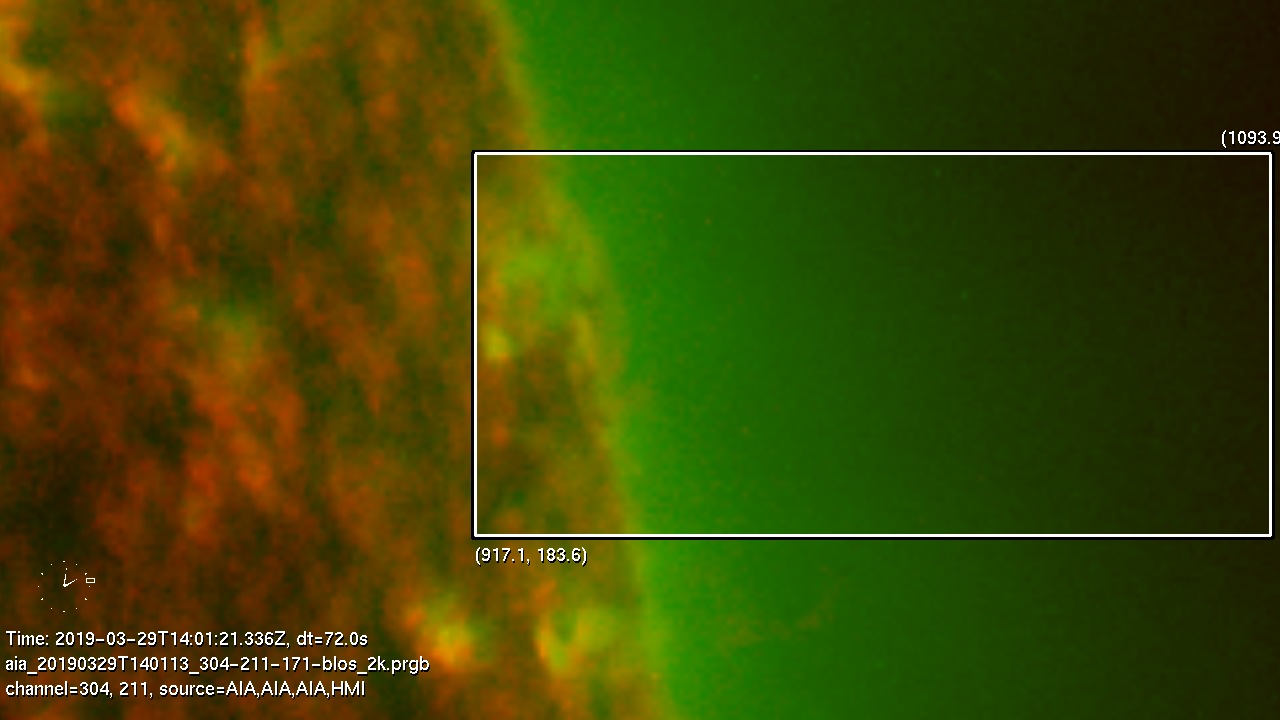
Fast and narrow, but not so collimated, eruption from the backside. A low-lying prominence is seen to be disturbed, so the source region may not be too far behind the limb. A narrow but bright CME is associated (http://spaceweather.gmu.edu/seeds/mkmovie.php?cme=20190329.162526.w031.v0489.p272&frame=10&r).
Rating:
3.0 (0=lowest, 5=highest)
Num Ratings:1
Detected by halocme, Submitted at 2019-03-30T07:20:27
2019-03-28T00:00:09 --> 2019-03-28T08:00:09
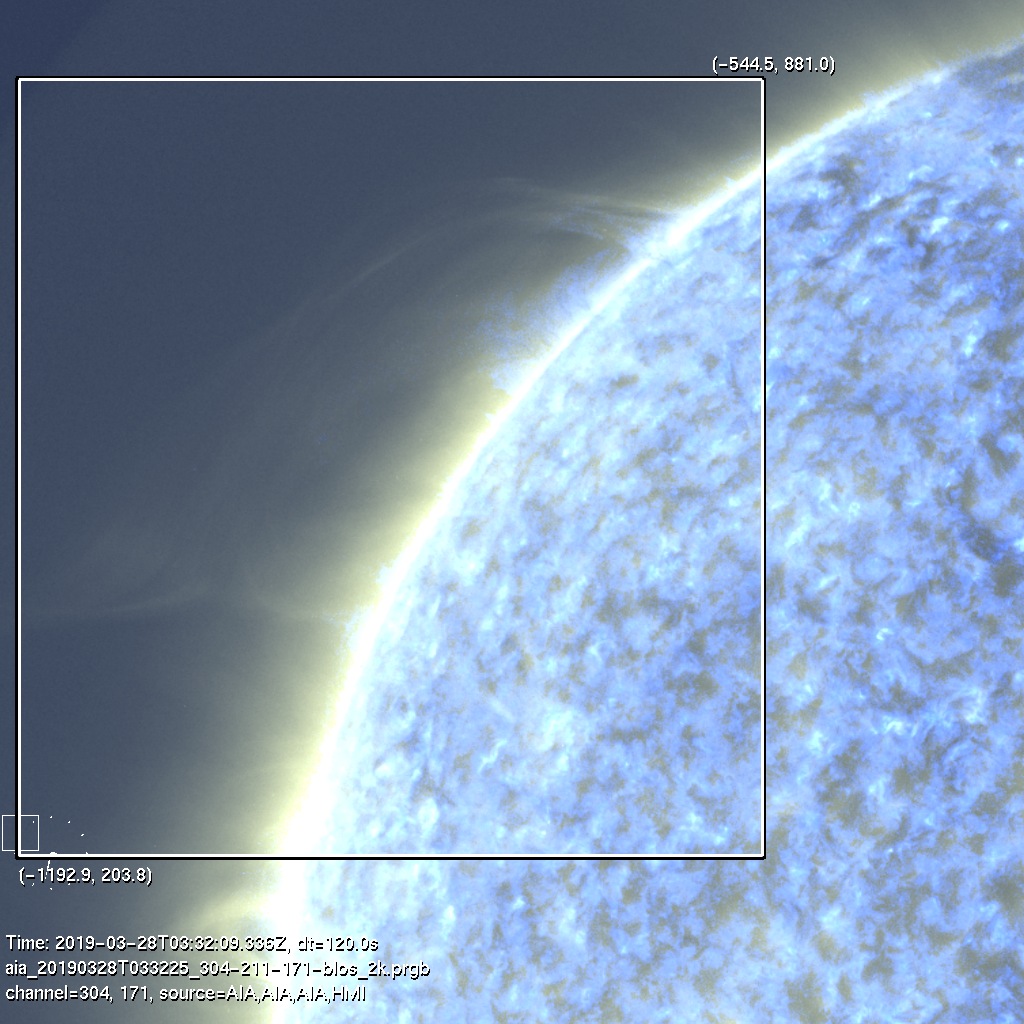
This gives an eruption that turbulent motions of a prominence system slowly let go the overlying structure seen in 171 A images. It is not clear what happened to the outward motions at greater heights - no CME.
Rating:
3.0 (0=lowest, 5=highest)
Num Ratings:1
Detected by halocme, Submitted at 2019-03-30T06:42:47
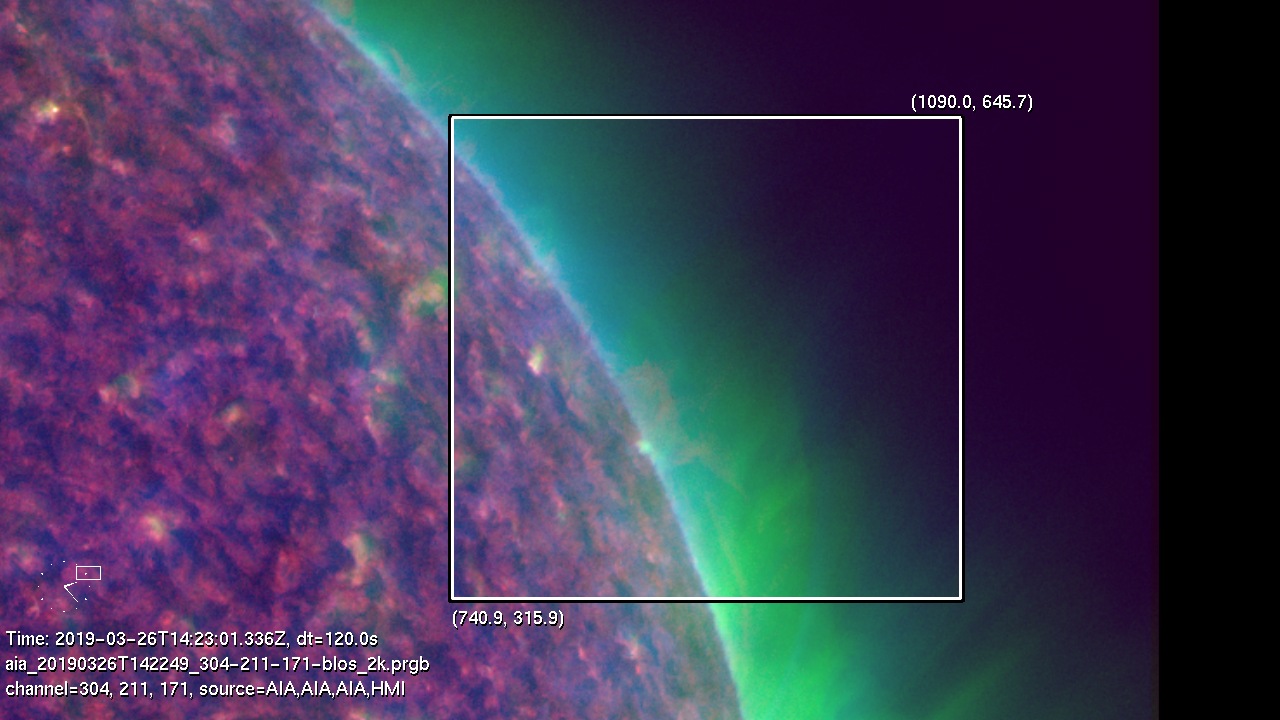
2019-03-26T13:15:01 --> 2019-03-26T15:01:01
Even though turbulent motions of a prominence preceded the eruption, it was probably triggered in a region slightly behind the limb. The associated CME is http://spaceweather.gmu.edu/seeds/mkmovie.php?cme=20190326.151211.w017.v0441.p282&frame=7&r.
Rating:
3.0 (0=lowest, 5=highest)
Num Ratings:1
Detected by halocme, Submitted at 2019-03-30T06:07:59
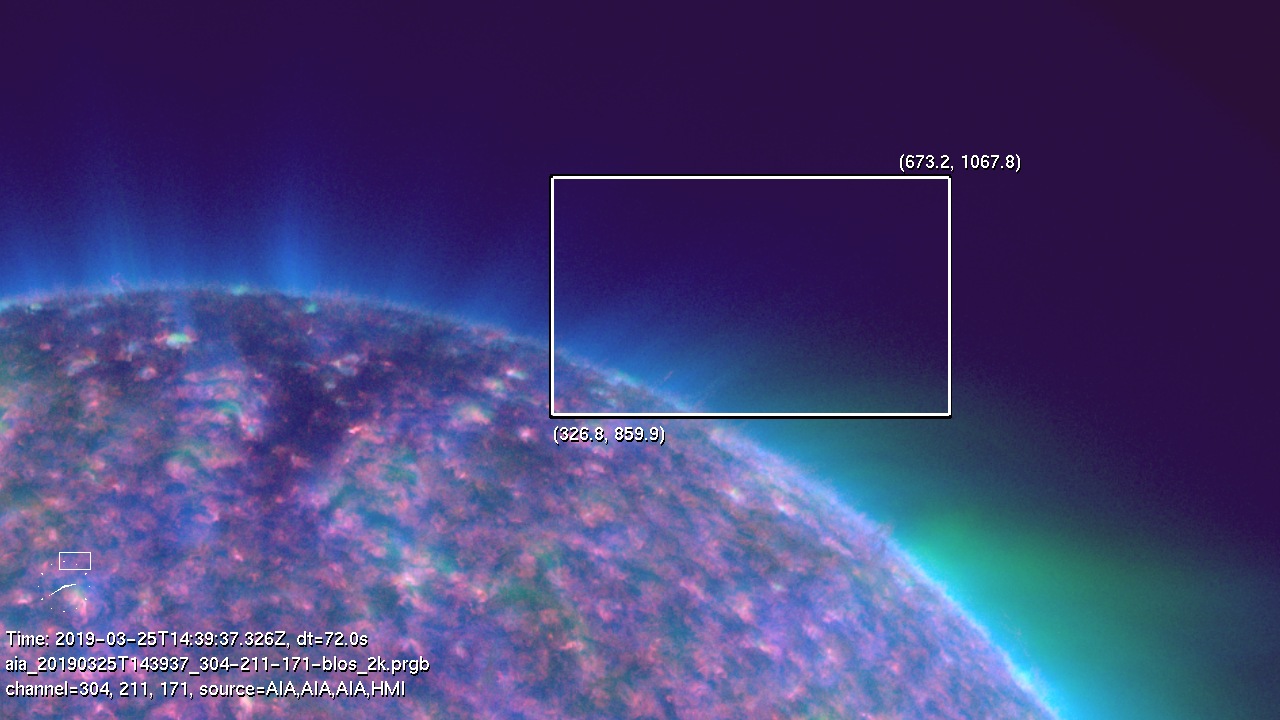
2019-03-25T13:20:25 --> 2019-03-25T14:40:49
This jet involves a cool helical structure seen in 304 A that delineates untwisting motions.
Rating:
3.0 (0=lowest, 5=highest)
Num Ratings:1
Detected by halocme, Submitted at 2019-03-30T06:02:29
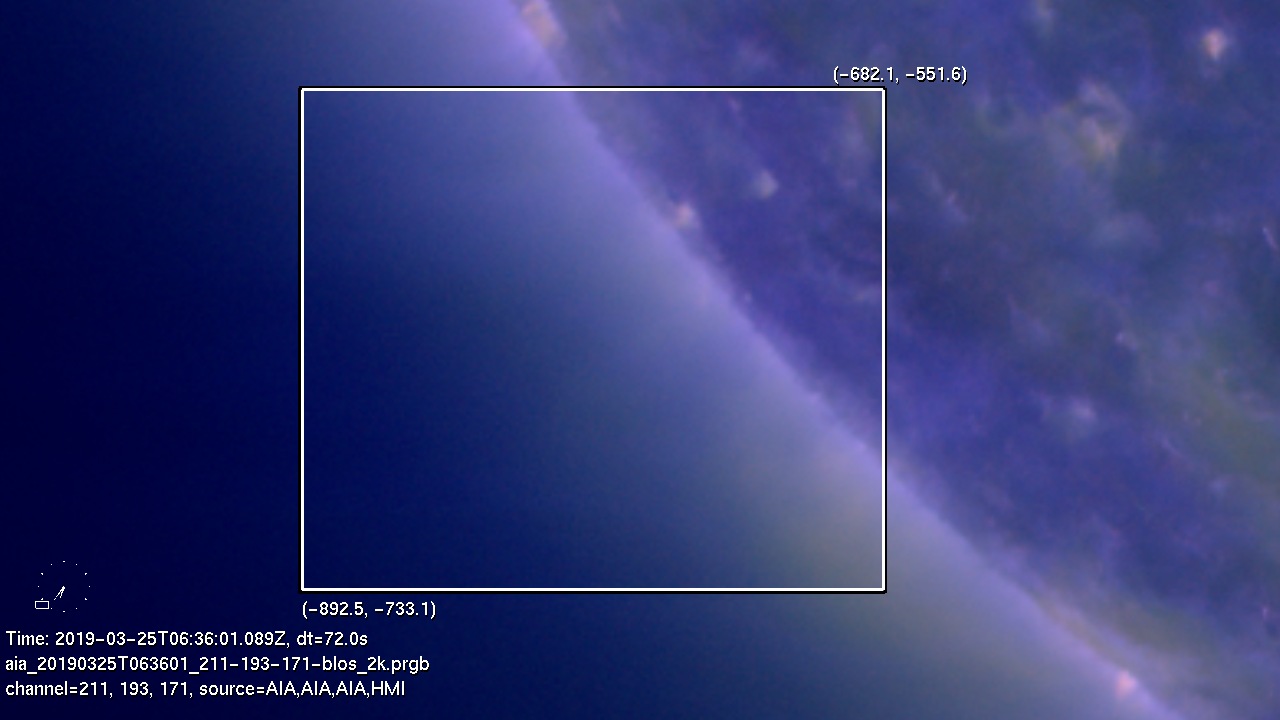
2019-03-25T05:30:01 --> 2019-03-25T06:39:37
The eruption seems to trace a large-scale closed structure.
Rating:
3.0 (0=lowest, 5=highest)
Num Ratings:1
Detected by halocme, Submitted at 2019-03-30T05:51:23
2019-03-25T02:45:01 --> 2019-03-25T03:45:01
This jet seems to contain a closed structure and flux rope. The ejection is non-radial.

Rating:
3.0 (0=lowest, 5=highest)
Num Ratings:1
Detected by halocme, Submitted at 2019-03-30T04:40:15
2019-03-24T11:55:13 --> 2019-03-24T12:39:37
This looks like a typical jet. No magnetic field elements are found near the footpoint in HMI Blos data. Adjacent areas also show contemporaneous jet-like activities, which is not too common.


Rating:
3.0 (0=lowest, 5=highest)
Num Ratings:1
Detected by halocme, Submitted at 2019-03-30T04:33:43
2019-03-24T11:55:13 --> 2019-03-24T12:39:37
test. delete this.


Rating:
3.0 (0=lowest, 5=highest)
Num Ratings:1
Detected by gchintzo, Submitted at 2019-03-11T21:32:12
2019-03-05T08:10:09 --> 2019-03-06T18:00:09
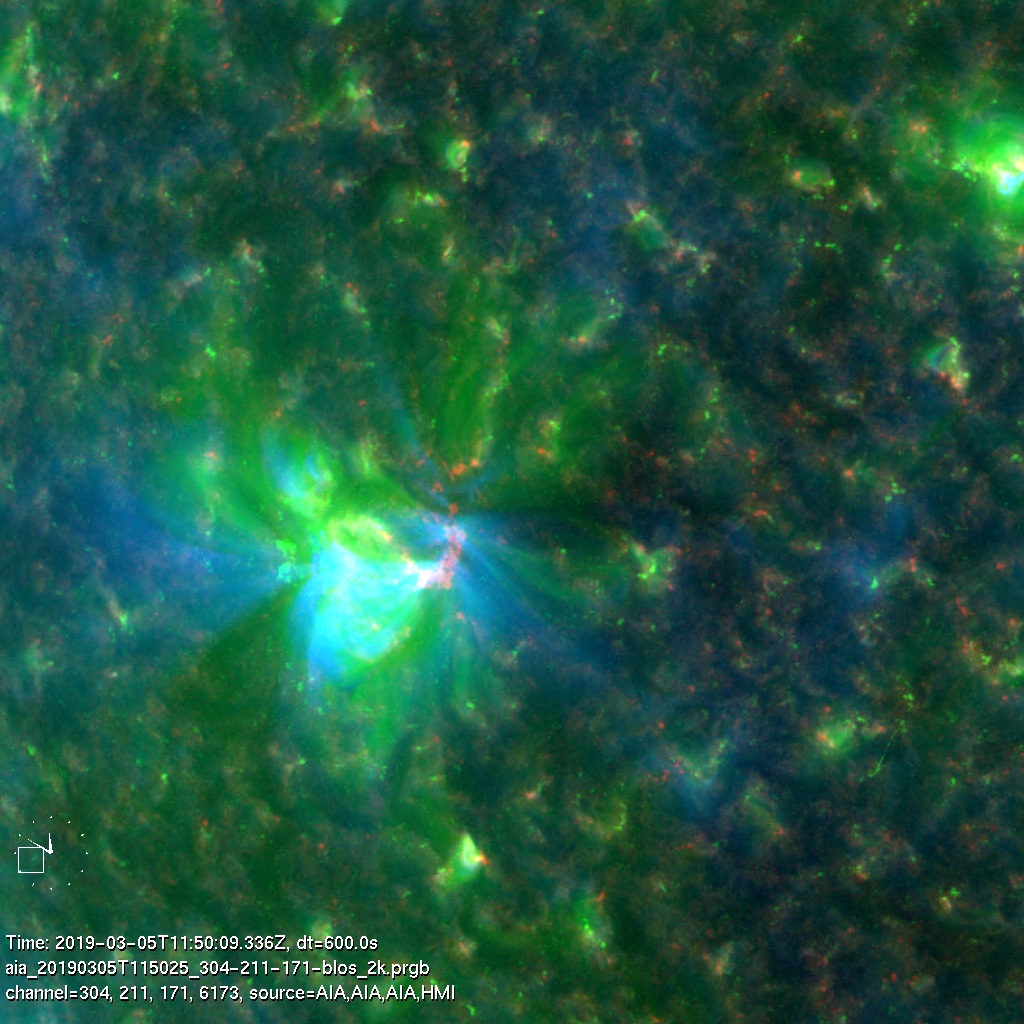
A decaying AR (unnamed by NOAA) in the south hemisphere of the sun. No significant activity (flares or CMEs) was produced by this region.