
Highest Rated Events (only 193 and 304 shown) All AR FE FL

Rating:
4.0 (0=lowest, 5=highest)
Num Ratings:1
Detected by halocme, Submitted at 2015-12-22T04:27:46
2015-12-19T12:15:34 --> 2015-12-19T14:25:10
The eruption originated around N05E110 (thanks to EUVI on STEREO-A). Reflecting the primary direction of the eruption, the front is seen to propagate mostly clockwise.


Rating:
4.0 (0=lowest, 5=highest)
Num Ratings:1
Detected by halocme, Submitted at 2015-12-22T04:18:10
2015-12-19T03:30:34 --> 2015-12-19T08:40:34
The filament lay in a quiescent region and slowly erupted, leaving two-ribbon brightening. The associated CME was also slow, something like 200 km/s.


Rating:
4.0 (0=lowest, 5=highest)
Num Ratings:1
Detected by halocme, Submitted at 2015-12-22T04:07:16
2015-12-19T01:50:22 --> 2015-12-19T04:10:22
This jet was preceded by a short duration (01:59, 02:04, 02:08) C3.1 flare in AR 12468. The flare briefly threw plasma northward, and the jet occurred as (cool) plasma came back to the flare region. The jet, ejected westward, also hd horizontal expanse, which seemed to trigger a brightening in the region to the north.


Rating:
4.0 (0=lowest, 5=highest)
Num Ratings:1
Detected by schryver, Submitted at 2015-12-21T20:14:25
2015-12-20T02:44:06 --> 2015-12-20T08:56:06
A set of loops over the E limb, above a region still behind the disk, rapidly reconfigures, as in an eruption, but without an obvious eruptive signature.


Rating:
4.0 (0=lowest, 5=highest)
Num Ratings:1
Detected by halocme, Submitted at 2015-12-21T07:46:09
2015-12-16T11:30:34 --> 2015-12-16T18:00:34
Although the erupting filament was not unambiguously identified, the post-eruption ribbons and arcades were seen to form gradually. It is likely that this eruption also contributed to the geomagnetic storm during 19-21 December.

Rating:
4.0 (0=lowest, 5=highest)
Num Ratings:1
Detected by halocme, Submitted at 2015-12-21T07:40:01
2015-12-16T07:00:06 --> 2015-12-16T10:00:06
An eruption local to AR 12468 opened up trans-equatorial loops, causing dimming near disk center. This was associated with a C6.6 flare. Dimming was seen in an extended area (See https://twitter.com/halocme/status/677063188777598976). Consistent with the prediction, this eruption seems to have arrived at L1 on December 19.


Rating:
4.0 (0=lowest, 5=highest)
Num Ratings:1
Detected by halocme, Submitted at 2015-12-21T07:40:00
2015-12-16T07:00:06 --> 2015-12-16T10:00:06
An eruption local to AR 12468 opened up trans-equatorial loops, causing dimming near disk center. This was associated with a C6.6 flare. Dimming was seen in an extended area (See https://twitter.com/halocme/status/677063188777598976). Consistent with the prediction, this eruption seems to have arrived at L1 on December 19.

Rating:
4.0 (0=lowest, 5=highest)
Num Ratings:1
Detected by schryver, Submitted at 2015-12-12T00:57:51
2015-12-10T12:32:06 --> 2015-12-10T17:24:06
Filament activation, and an apparently associated coronal reconfiguration (possibly around a null) in a leading AR.


Rating:
4.0 (0=lowest, 5=highest)
Num Ratings:1
Detected by schryver, Submitted at 2015-12-10T23:28:20
2015-12-09T01:24:06 --> 2015-12-09T21:28:06
Null point activity between adjacent, connected regions.

Rating:
4.0 (0=lowest, 5=highest)
Num Ratings:1
Detected by halocme, Submitted at 2015-12-07T20:38:13
2015-12-07T13:50:22 --> 2015-12-07T16:00:22
This is a quite powerful eruption causing adjacent loops to oscillate. The source region is ~20 degrees behind the limb as found by EUVI on STEREO-A (see https://twitter.com/halocme/status/673901884822806528).

Rating:
4.0 (0=lowest, 5=highest)
Num Ratings:1
Detected by halocme, Submitted at 2015-12-06T08:16:39
2015-12-04T16:35:22 --> 2015-12-04T18:35:22
This originated in AR 12462. The disturbances caused by the eruption were extensive, seen both over the limb and across the disk. Contrary to an expectation, the NOAA event list does not report a type II burst.

Rating:
4.0 (0=lowest, 5=highest)
Num Ratings:1
Detected by halocme, Submitted at 2015-12-06T08:16:38
2015-12-04T16:35:22 --> 2015-12-04T18:35:22
This originated in AR 12462. The disturbances caused by the eruption were extensive, seen both over the limb and across the disk. Contrary to an expectation, the NOAA event list does not report a type II burst.
Rating:
4.0 (0=lowest, 5=highest)
Num Ratings:1
Detected by halocme, Submitted at 2015-12-02T03:26:20
2015-12-01T07:45:34 --> 2015-12-01T09:00:34
This flare in AR 12458 accompanied fast-mode MHD waves, seen as a large-scale coronal propagating front (LCPF) both on disk and over the limb and narrow wave trains in the direction of 1 o'clock. Possibly because of the well-connected location, an electron event was observed by ACE/EPAM (but not protons).

Rating:
4.0 (0=lowest, 5=highest)
Num Ratings:1
Detected by halocme, Submitted at 2015-11-24T21:23:45
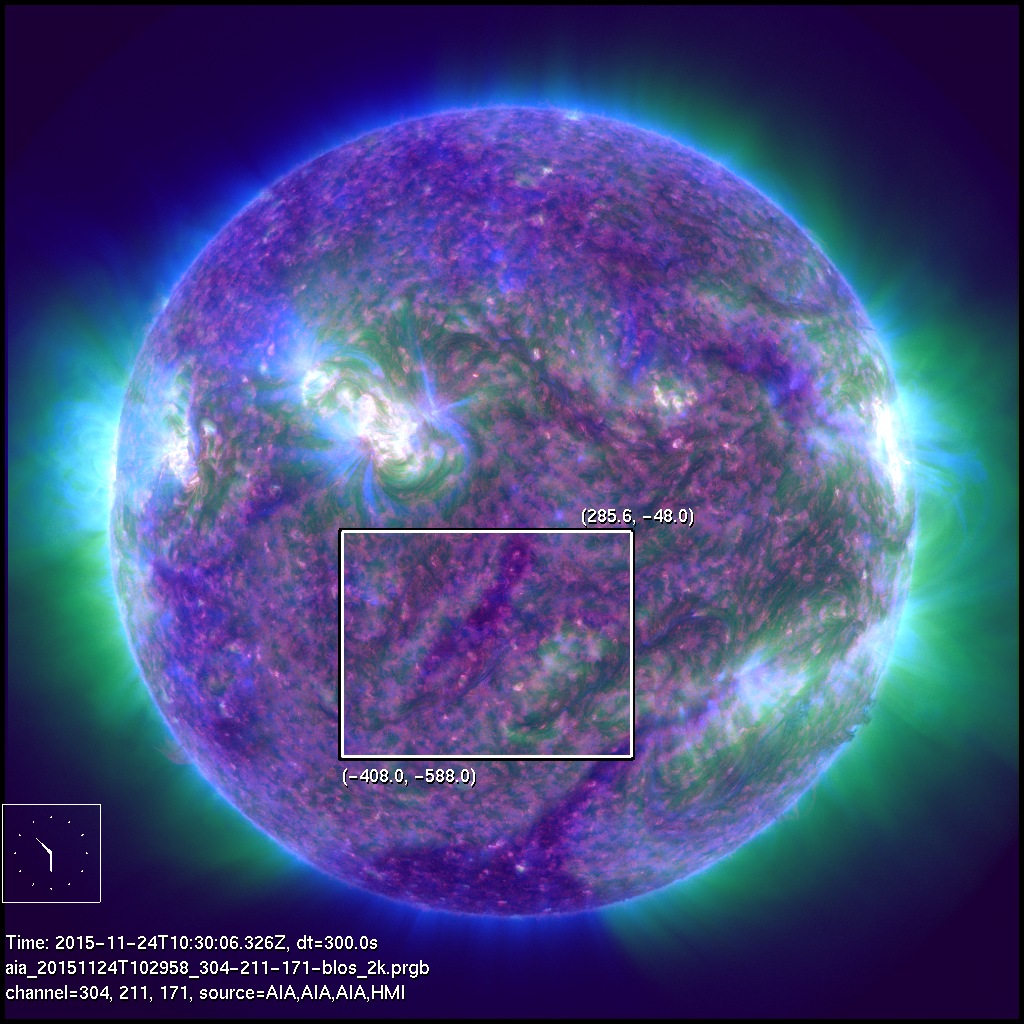
2015-11-24T08:00:06 --> 2015-11-24T16:00:06
It is hard to tracxe the origin of this eruption, which was not associated with a GOES X-ray flare. The formaiton of spreading flare ribbons and post-eruption arcades became clear only after 12:00 UT or so. Its location may provide interesting effects on its encouter with the Earth. Although no clear CME was found in LASCO data (not surprising given its modest extent), the erutpion could have been deflected by two coronal holes, small narrow one to the northeast and big coronal hole covering the south pole. We will see...
Rating:
4.0 (0=lowest, 5=highest)
Num Ratings:1
Detected by halocme, Submitted at 2015-11-15T01:51:54
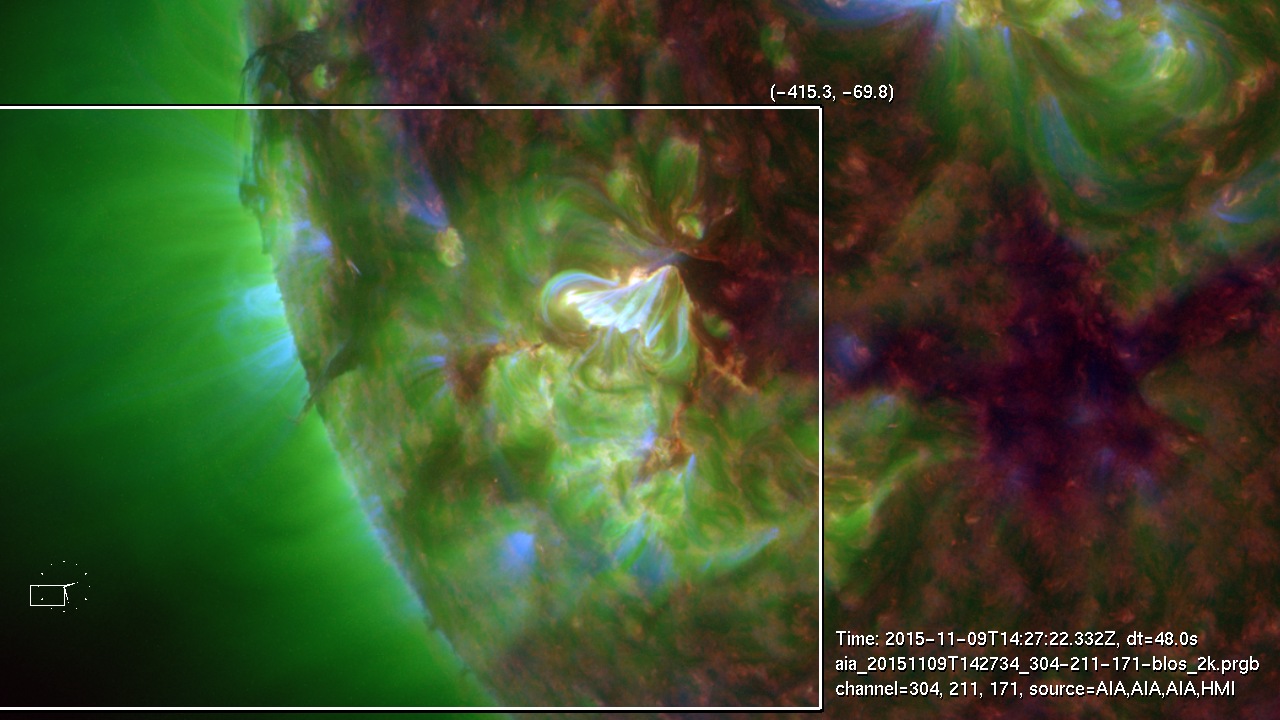
2015-11-09T12:30:34 --> 2015-11-09T14:30:34
This is a big eruption resulting in a partial halo CME. A large-scale coronal propagating front (LCPF) is seen, but it mostly goes to the radial direction due to the coronal hole to the west.
Rating:
4.0 (0=lowest, 5=highest)
Num Ratings:1
Detected by halocme, Submitted at 2015-11-15T01:51:53
2015-11-09T12:30:34 --> 2015-11-09T14:30:34
This is a big eruption resulting in a partial halo CME. A large-scale coronal propagating front (LCPF) is seen, but it mostly goes to the radial direction due to the coronal hole to the west.
Rating:
4.0 (0=lowest, 5=highest)
Num Ratings:1
Detected by halocme, Submitted at 2015-11-12T23:02:01
2015-11-11T11:00:06 --> 2015-11-11T21:00:06
This is a good example of stealthy eruption that can easily escape our attention unless we track the region for long time. We see the formation of spreading flare ribbons, post-eruption arcades and dimming, which we had to wait for several hours to confirm. Note that ribbon emission extends into coronal holes both to the northwest and south. A diffuse wide (partial halo) CME was seen by LASCO.

Rating:
4.0 (0=lowest, 5=highest)
Num Ratings:1
Detected by schryver, Submitted at 2015-11-05T21:53:42
2015-11-04T03:24:06 --> 2015-11-04T05:52:06
A substantial filament in the interior of an AR activates, displaying briefly its twist.


Rating:
4.0 (0=lowest, 5=highest)
Num Ratings:1
Detected by schryver, Submitted at 2015-11-05T21:52:26
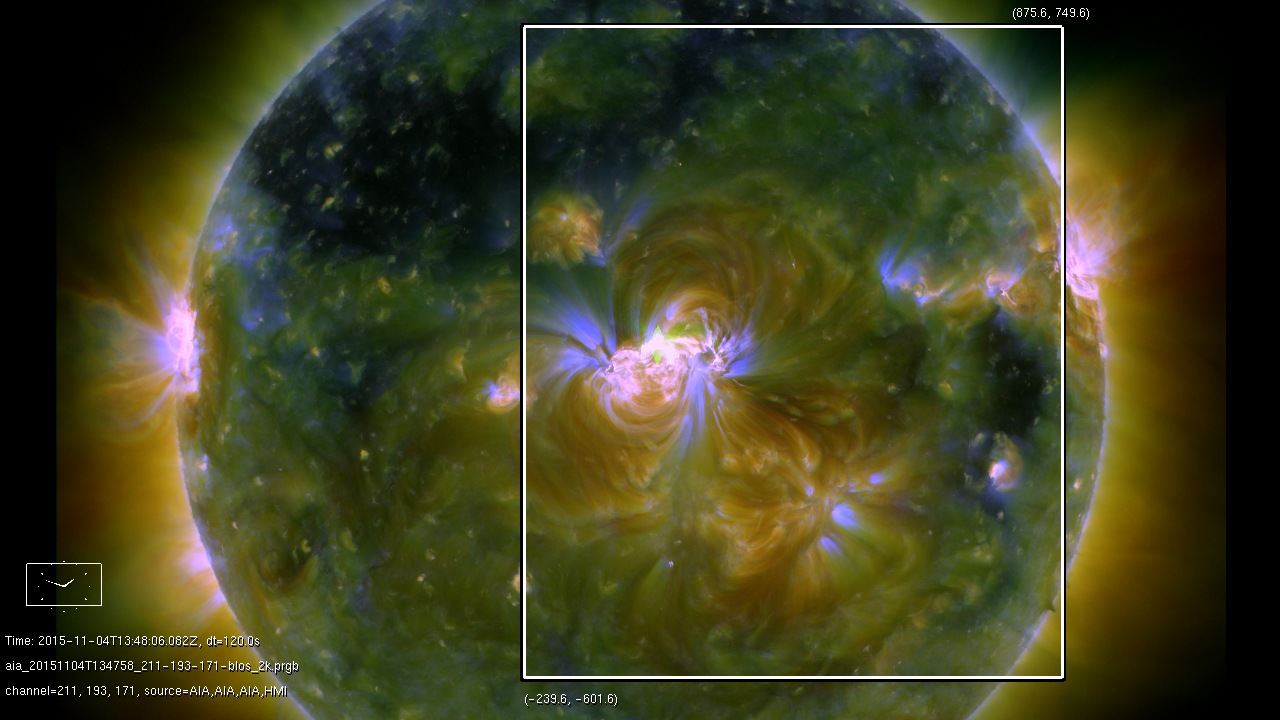
2015-11-04T13:16:06 --> 2015-11-04T15:08:06
An eruptive mid-M class flare occurs in a largely isolated, large AR very near DC. A coronal propagating front is seen moving through QS corona around it primarily towards the N, W, and SW.
Rating:
4.0 (0=lowest, 5=highest)
Num Ratings:1
Detected by schryver, Submitted at 2015-11-05T21:52:25
2015-11-04T13:16:06 --> 2015-11-04T15:08:06
An eruptive mid-M class flare occurs in a largely isolated, large AR very near DC. A coronal propagating front is seen moving through QS corona around it primarily towards the N, W, and SW.