
Highest Rated Events (only 193 and 304 shown) All AR FE FL

Rating:
3.0 (0=lowest, 5=highest)
Num Ratings:1
Detected by schryver, Submitted at 2013-10-29T00:00:19
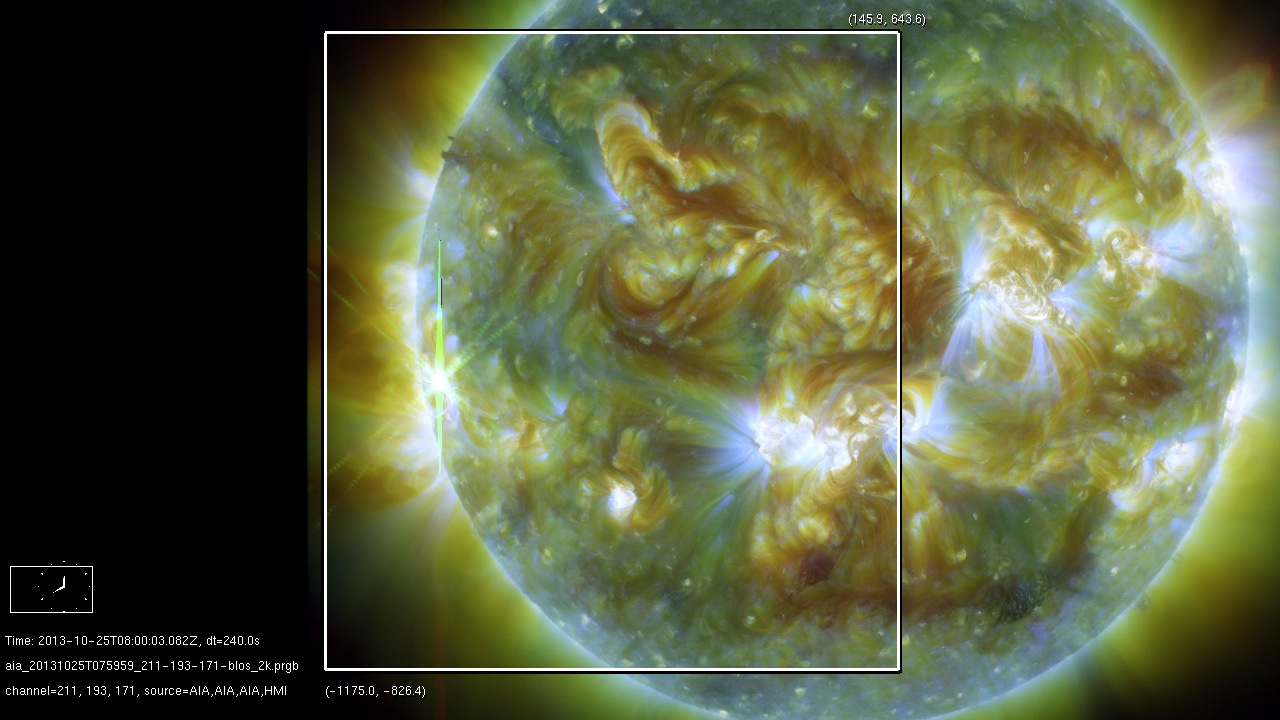
2013-10-25T07:20:03 --> 2013-10-25T12:48:03
A major flare occurs in a compact AR towards the E limb in the S hemisphere. A coronal propagating front can be seen to proceed over a large opening angle on disk and over the limb. A filament in the S hemisphere activates, potentialy in response to the coronal perturbation.

Rating:
3.0 (0=lowest, 5=highest)
Num Ratings:1
Detected by schryver, Submitted at 2013-10-28T23:51:10
2013-10-24T00:00:07 --> 2013-10-24T07:40:07
High-latitude (S pole) filament activation.

Rating:
3.0 (0=lowest, 5=highest)
Num Ratings:1
Detected by anny, Submitted at 2013-10-22T19:50:39
2013-10-20T10:52:03 --> 2013-10-20T14:34:03
A flux rope visually kinks and a dark blob in 304A lifts off close to disk center. I am not sure if it later erupts or falls back to the surface, but if it erupts, it might be directed earthwards. This event is followed by some loop wiggling and brightening in the surrounding corona.


Rating:
3.0 (0=lowest, 5=highest)
Num Ratings:1
Detected by anny, Submitted at 2013-10-22T19:47:46
2013-10-20T07:50:03 --> 2013-10-20T11:20:03
A large-scale spray surge is followed by a coronal dimming in the connected region.

Rating:
3.0 (0=lowest, 5=highest)
Num Ratings:1
Detected by anny, Submitted at 2013-10-22T19:47:44
2013-10-20T07:50:03 --> 2013-10-20T11:20:03
A large-scale spray surge is followed by a coronal dimming in the connected region.

Rating:
3.0 (0=lowest, 5=highest)
Num Ratings:1
Detected by anny, Submitted at 2013-10-22T19:40:47
2013-10-19T11:38:03 --> 2013-10-19T22:40:03
A filament slowly takes off the northern part of the disk and lifts above the northern limb. It forms a rather impressive cloud-like prominence, with part of it perhaps arupting, but most of it simply rains back to the surface, but on the other side of the central meridian.


Rating:
3.0 (0=lowest, 5=highest)
Num Ratings:1
Detected by anny, Submitted at 2013-10-22T19:31:12
2013-10-18T00:00:03 --> 2013-10-18T07:21:03
An eruption of a large (extending to a good quarter of the disk) filament north-eastwards in the plane of sky.

Rating:
3.0 (0=lowest, 5=highest)
Num Ratings:1
Detected by weiliu, Submitted at 2013-10-22T03:12:30
2013-10-01T14:00:03 --> 2013-10-01T20:00:03
high latitude prominence eruption in the southern polar region.


Rating:
3.0 (0=lowest, 5=highest)
Num Ratings:1
Detected by schryver, Submitted at 2013-10-18T00:22:48
2013-10-16T18:00:03 --> 2013-10-17T21:00:03
Gradual rise and disappearance of a prominence over the NW limb.


Rating:
3.0 (0=lowest, 5=highest)
Num Ratings:1
Detected by schryver, Submitted at 2013-10-18T00:16:47
2013-10-16T14:24:03 --> 2013-10-16T18:52:03
Eruption from a small emerging flux region associated with a faint propagating disturbance mainly towards the N into QS corona.

Rating:
3.0 (0=lowest, 5=highest)
Num Ratings:1
Detected by schryver, Submitted at 2013-10-18T00:12:54
2013-10-16T05:04:03 --> 2013-10-16T08:48:03
W-limb eruption

Rating:
3.0 (0=lowest, 5=highest)
Num Ratings:1
Detected by schryver, Submitted at 2013-10-16T23:14:31
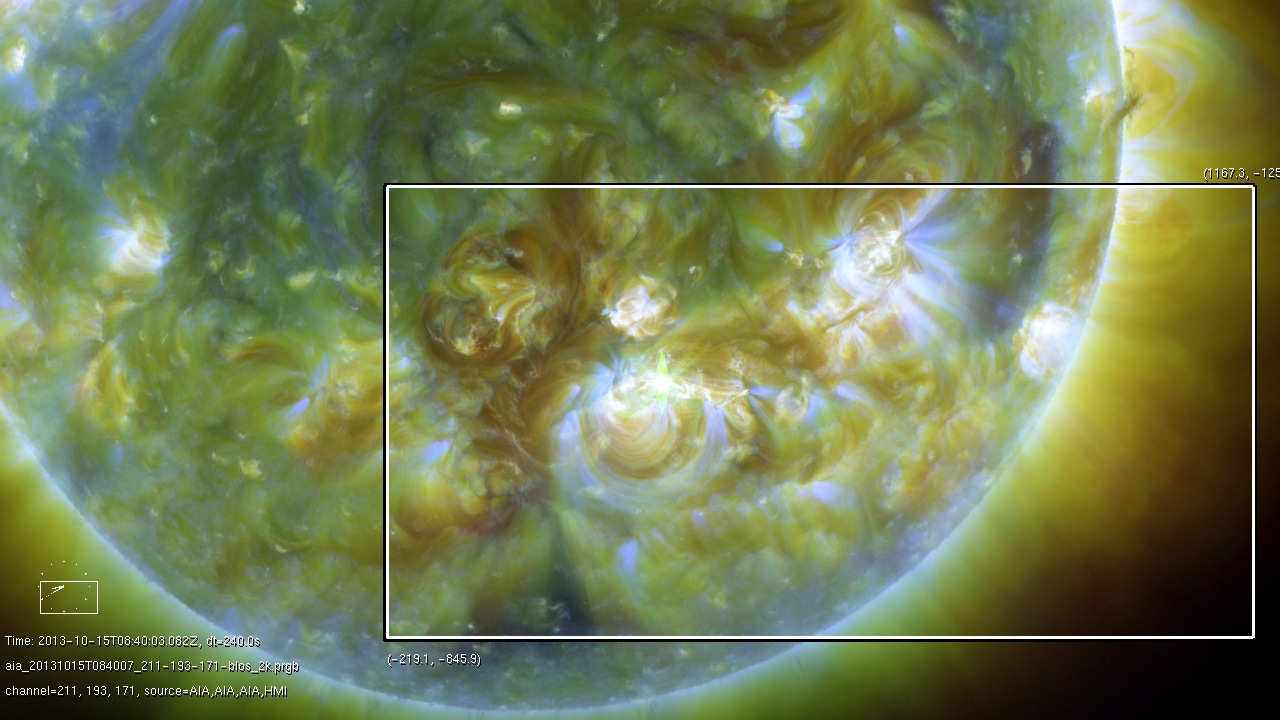
2013-10-15T00:00:03 --> 2013-10-16T03:00:03
Smallish active regions and their surroundings exhibit multiple eruptions and flares (high-C and low-M) as activity couples from one region into another, including high over the SW limb.

Rating:
3.0 (0=lowest, 5=highest)
Num Ratings:1
Detected by halocme, Submitted at 2013-10-16T02:55:36
2013-10-13T00:00:03 --> 2013-10-13T02:30:03
The M1.7 flare associated with a halo CME and large-scale coronal propagating front is accompanied by activities in other regions. Four regions are seen to flare or erupt. Let's call them 1, 2, 3 and 4 from east to west. Obviously region 3 was the first (C1.2 flare minutes before the M1.7 flare), but regions 1, 2 and 4 seem to nearly simultaneously erupt. The apparent halo may be contributed by more than region 2, responsible for the M1.7 flare.

Rating:
3.0 (0=lowest, 5=highest)
Num Ratings:1
Detected by halocme, Submitted at 2013-10-16T02:55:35
2013-10-13T00:00:03 --> 2013-10-13T02:30:03
The M1.7 flare associated with a halo CME and large-scale coronal propagating front is accompanied by activities in other regions. Four regions are seen to flare or erupt. Let's call them 1, 2, 3 and 4 from east to west. Obviously region 3 was the first (C1.2 flare minutes before the M1.7 flare), but regions 1, 2 and 4 seem to nearly simultaneously erupt. The apparent halo may be contributed by more than region 2, responsible for the M1.7 flare.

Rating:
3.0 (0=lowest, 5=highest)
Num Ratings:1
Detected by halocme, Submitted at 2013-10-16T02:45:01
2013-10-13T00:00:03 --> 2013-10-13T02:30:03
This eruption is associated with a halo CME observed by LASCO. The front does not appear sharp, and it becomes clear only far from the flare location.

Rating:
3.0 (0=lowest, 5=highest)
Num Ratings:1
Detected by halocme, Submitted at 2013-10-16T02:44:58
2013-10-13T00:00:03 --> 2013-10-13T02:30:03
This eruption is associated with a halo CME observed by LASCO. The front does not appear sharp, and it becomes clear only far from the flare location.
Rating:
3.0 (0=lowest, 5=highest)
Num Ratings:1
Detected by halocme, Submitted at 2013-10-16T02:36:23
2013-10-13T10:30:35 --> 2013-10-13T16:00:35
This prominence seems to gradually collapse down. The overlying corona is seen to dim slowly. This may be the origin of the slow, diffuse and structured CME, whose first appearance in LASCO data is not well defined.

Rating:
3.0 (0=lowest, 5=highest)
Num Ratings:1
Detected by halocme, Submitted at 2013-10-16T02:36:21
2013-10-13T10:30:35 --> 2013-10-13T16:00:35
This prominence seems to gradually collapse down. The overlying corona is seen to dim slowly. This may be the origin of the slow, diffuse and structured CME, whose first appearance in LASCO data is not well defined.
Rating:
3.0 (0=lowest, 5=highest)
Num Ratings:1
Detected by halocme, Submitted at 2013-10-16T02:36:20
2013-10-13T10:30:35 --> 2013-10-13T16:00:35
This prominence seems to gradually collapse down. The overlying corona is seen to dim slowly. This may be the origin of the slow, diffuse and structured CME, whose first appearance in LASCO data is not well defined.
Rating:
3.0 (0=lowest, 5=highest)
Num Ratings:1
Detected by halocme, Submitted at 2013-10-16T02:28:51
2013-10-13T10:30:35 --> 2013-10-13T16:00:35
Mass is seen to move from one leg to another of the prominence. These motions may underlie an eruption. But the overlying corona does not seem to be affected. The possibly associated CME is narrow.
