
Highest Rated Events (only 193 and 304 shown) All AR FE FL

Rating:
3.0 (0=lowest, 5=highest)
Num Ratings:1
Detected by anny, Submitted at 2014-01-03T23:06:42
2013-12-09T14:14:03 --> 2013-12-09T20:28:03
A small prominence resides on the NE limb for at least half a day, and a faint small cavity can be seen on its top. Eventually, perhaps disturbed by the activity in the nearby AR, the cavity takes off, while the prominence does not seem to follow along, it falls down to the surface as a coronal rain.


Rating:
3.0 (0=lowest, 5=highest)
Num Ratings:1
Detected by anny, Submitted at 2014-01-03T23:06:41
2013-12-09T14:14:03 --> 2013-12-09T20:28:03
A small prominence resides on the NE limb for at least half a day, and a faint small cavity can be seen on its top. Eventually, perhaps disturbed by the activity in the nearby AR, the cavity takes off, while the prominence does not seem to follow along, it falls down to the surface as a coronal rain.

Rating:
3.0 (0=lowest, 5=highest)
Num Ratings:1
Detected by anny, Submitted at 2014-01-03T23:01:54
2013-12-09T10:32:03 --> 2013-12-09T12:54:03
A small filament at the core of an AR on the E disk erupts forming an extended surge off the limb.


Rating:
3.0 (0=lowest, 5=highest)
Num Ratings:1
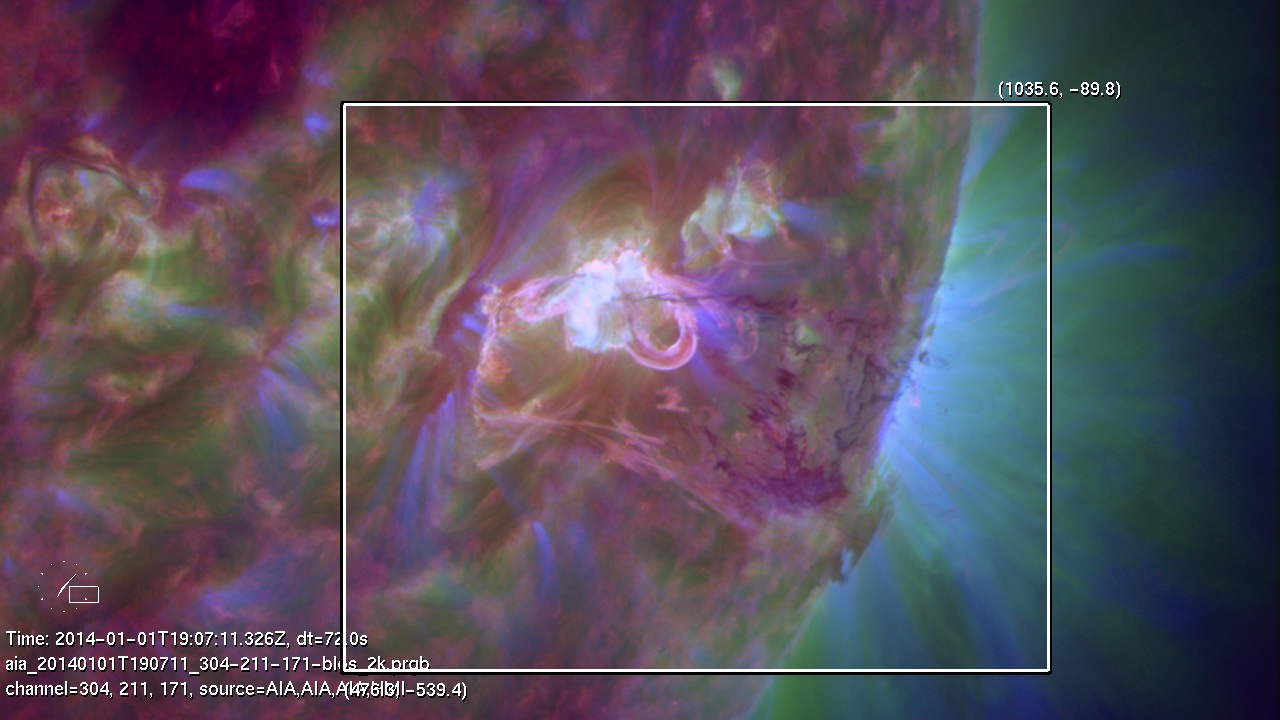
Detected by halocme, Submitted at 2014-01-02T20:25:23
2014-01-01T18:20:23 --> 2014-01-01T19:40:47
This flare is quite similar to the last major (M6.4) flare in 2013 from the same region (AR 11936). Although the way the filament erupted was spectacular because they looked fragmented, it was almost a failed eruption. Most of the stuff came back. The associated CMEs were wimpy at best. The CME associated with the M9.9 flare was a little more decent than that with the M6.4 flare partly because of its location closer to the limb and possibly larger energy released.
Rating:
3.0 (0=lowest, 5=highest)
Num Ratings:1
Detected by halocme, Submitted at 2014-01-01T02:34:35
2013-12-31T21:00:35 --> 2013-12-31T23:00:35
This M6.4 flare does not look like fully successful sending coronal plasma to interplanetary space, although no LASCO data are available yet to confirm it. The ejected material is seen to largely fall back and there are hardly large-scale disturbances. The motions give an impression of counter-clockwise rotation.

Rating:
3.0 (0=lowest, 5=highest)
Num Ratings:1
Detected by halocme, Submitted at 2014-01-01T02:34:33
2013-12-31T21:00:35 --> 2013-12-31T23:00:35
This M6.4 flare does not look like fully successful sending coronal plasma to interplanetary space, although no LASCO data are available yet to confirm it. The ejected material is seen to largely fall back and there are hardly large-scale disturbances. The motions give an impression of counter-clockwise rotation.
Rating:
3.0 (0=lowest, 5=highest)
Num Ratings:1
Detected by halocme, Submitted at 2013-12-31T19:18:17
2013-12-31T10:10:12 --> 2013-12-31T11:59:24
This coronal dimming is associated with a bright CME first seen at 10:36 (marginal) or 10:48. The source region of the eruption was slightly behind the limb; if it had been far behind the limb the associated flare (C8.9) would not have been observed. Is this the last big event in 2013 with 12 hours remaining?


Rating:
3.0 (0=lowest, 5=highest)
Num Ratings:1
Detected by halocme, Submitted at 2013-12-31T19:18:17
2013-12-31T10:10:12 --> 2013-12-31T11:59:24
This coronal dimming is associated with a bright CME first seen at 10:36 (marginal) or 10:48. The source region of the eruption was slightly behind the limb; if it had been far behind the limb the associated flare (C8.9) would not have been observed. Is this the last big event in 2013 with 12 hours remaining?
Rating:
3.0 (0=lowest, 5=highest)
Num Ratings:1
Detected by halocme, Submitted at 2013-12-30T01:25:56
2013-12-14T06:20:23 --> 2013-12-14T07:10:23
According to EUVI on STEREO-B, a flare occurred around 2013/12/14 06:10 at S16E137 from Earth view. It was probably only a M-class flare and the eruption in EUVI images was not global. However, AIA clearly saw the eruption. This was presumably because the eruption was largely toward west. A bright, although not wide, CME was associated (06:36 UT by LASCO C2), and a one-minute-long type II burst was reported from Learmonth.

Rating:
3.0 (0=lowest, 5=highest)
Num Ratings:1
Detected by halocme, Submitted at 2013-12-29T19:29:38
2013-12-29T03:00:03 --> 2013-12-29T10:00:03
A fat, slow, flux-rope CME was seen by LASCO (central position angle of 140 deg) at 06:36 UT or even before, and its source region is arguably behind the east limb. The running difference movie shows an eruption near the SE limb (S12E50), starting around 03:30 and taking off around 04:20 UT. But the off-limb outward motions later (06:30'ish) may be more closely linked to the CME. In order for both AIA and EUVI-B (at 150 behind the Sun-Earth line, only beacon data at 09:06 is available for now after 00:06) to detect them over the east and west limb, respectively, the source region is probably 30 degrees or so beind the limb. Life would have been much easier if STEREO had remained in quadrature with the Earth.


Rating:
3.0 (0=lowest, 5=highest)
Num Ratings:1
Detected by weiliu, Submitted at 2013-12-27T20:35:15
2013-12-06T23:00:03 --> 2013-12-07T01:10:03
A surge launched on the southeast limb.

Rating:
3.0 (0=lowest, 5=highest)
Num Ratings:1
Detected by halocme, Submitted at 2013-12-27T18:01:02
2013-12-26T02:10:11 --> 2013-12-26T02:59:23
LASCO observed a bright halo CME at 2013/12/26 03:12 UT. The source region seems to be at approximately S10 E15 from STEREO-B, which is 151 degrees behind the Sun-Earth line. So AIA has recorded an eruption from 76 degrees behind the limb. No flare is associated, of course.

Rating:
3.0 (0=lowest, 5=highest)
Num Ratings:1
Detected by weiliu, Submitted at 2013-12-26T21:48:41
2013-12-05T20:00:03 --> 2013-12-05T22:00:03
Persistent coronal rain in an arcade of large-scale loops on the SE limb, with episodic increases in the amount of condensation appearing at the apex the loop.

Rating:
3.0 (0=lowest, 5=highest)
Num Ratings:1
Detected by weiliu, Submitted at 2013-12-26T21:43:20
2013-12-05T20:00:03 --> 2013-12-06T00:00:03
A filament in the peripheral of an active region and next to a coronal hole to the north erupted, producing a two-ribbon flare; it's like associated with a CME and coronal EUV wave.

Rating:
3.0 (0=lowest, 5=highest)
Num Ratings:1
Detected by weiliu, Submitted at 2013-12-26T21:43:18
2013-12-05T20:00:03 --> 2013-12-06T00:00:03
A filament in the peripheral of an active region and next to a coronal hole to the north erupted, producing a two-ribbon flare; it's like associated with a CME and coronal EUV wave.

Rating:
3.0 (0=lowest, 5=highest)
Num Ratings:1
Detected by weiliu, Submitted at 2013-12-21T22:11:47
2013-12-12T00:00:03 --> 2013-12-12T04:00:03
Rolling prominence material on the west limb.

Rating:
3.0 (0=lowest, 5=highest)
Num Ratings:1
Detected by weiliu, Submitted at 2013-12-21T21:30:07
2013-12-11T05:30:03 --> 2013-12-11T08:30:03
A filament eruption near the SE limb, exhibiting unwinding twists.

Rating:
3.0 (0=lowest, 5=highest)
Num Ratings:1
Detected by halocme, Submitted at 2013-12-01T19:00:42
2013-11-25T13:00:03 --> 2013-11-25T21:00:03
The filament is not outstanding before the activation. Although images in 304 A emphasize downward motions, some of the prominence material may have erupted. There is a marginal CME with its western leg corresponding to the western end of the filament.

Rating:
3.0 (0=lowest, 5=highest)
Num Ratings:1
Detected by halocme, Submitted at 2013-12-01T19:00:41
2013-11-25T13:00:03 --> 2013-11-25T21:00:03
The filament is not outstanding before the activation. Although images in 304 A emphasize downward motions, some of the prominence material may have erupted. There is a marginal CME with its western leg corresponding to the western end of the filament.
Rating:
3.0 (0=lowest, 5=highest)
Num Ratings:1
Detected by halocme, Submitted at 2013-12-01T18:44:35
2013-11-24T07:40:11 --> 2013-11-24T09:40:11
A limited portion of the coronal volume is seen to dim, most pronouncedly in 193 A images, as a disturbance sweeps it westward. The nature of the disturbance is TBD.
