
Highest Rated Events (only 193 and 304 shown) All AR FE FL

Rating:
3.0 (0=lowest, 5=highest)
Num Ratings:1
Detected by weiliu, Submitted at 2014-02-10T02:14:35
2012-01-19T04:15:04 --> 2012-01-19T10:00:04
304 cool material condenses out of nowhere at a cusp (dip) seen at 171. Similar coronal condensation forming prominence/coronal rain has recently been captured (Liu, Berger, Low 2012, ApJ Letters). Shortly after this condensation, a nearby large filament/prominence erupted.


Rating:
3.0 (0=lowest, 5=highest)
Num Ratings:1
Detected by cheung, Submitted at 2014-02-10T02:14:33
2012-05-29T17:00:04 --> 2012-05-29T18:30:04
Much of the material apparently drains back toward the footpoints of the surge.


Rating:
3.0 (0=lowest, 5=highest)
Num Ratings:1
Detected by cheung, Submitted at 2014-02-10T02:14:29
2012-10-08T23:00:03 --> 2012-10-09T01:30:03
A small filament eruption from behind the limb leads to a flare, and possibly to the sudden appearance of filamentary material in loops north of the erupting region.


Rating:
3.0 (0=lowest, 5=highest)
Num Ratings:1
Detected by cheung, Submitted at 2014-02-10T02:14:28
2012-02-04T19:00:04 --> 2012-02-06T03:00:04
Typical of a coronal cavity observed with AIA, there is a quiescent filament sitting underneath.

Rating:
3.0 (0=lowest, 5=highest)
Num Ratings:1
Detected by cheung, Submitted at 2014-02-10T02:14:27
2012-04-07T12:00:04 --> 2012-04-09T00:00:04
Coronal cavity with long, vertical strands of filamentary materia beneath it.


Rating:
3.0 (0=lowest, 5=highest)
Num Ratings:1
Detected by cheung, Submitted at 2014-02-10T02:14:26
2012-10-08T23:00:03 --> 2012-10-09T01:30:03
A small filament eruption from behind the limb leads to a flare, and possibly to the sudden appearance of filamentary material in loops north of the erupting region.
Rating:
3.0 (0=lowest, 5=highest)
Num Ratings:1
Detected by cheung, Submitted at 2014-02-10T02:14:25
2012-05-30T01:40:04 --> 2012-05-30T03:20:04
The rise of the filament material is halted and the material drains back down to the footpoints of the relaxed magnetic structure.

Rating:
3.0 (0=lowest, 5=highest)
Num Ratings:1
Detected by cheung, Submitted at 2014-02-10T02:14:25
2012-02-04T13:00:04 --> 2012-02-04T14:00:04
The absence of footpoint brightenings indicates the source region is on the far side.

Rating:
3.0 (0=lowest, 5=highest)
Num Ratings:1
Detected by cheung, Submitted at 2014-02-10T02:14:25
2012-02-05T18:40:04 --> 2012-02-05T23:40:04
The filament seems to lift off to the north. Twisting motion is particularly pronounced near the east end of the filament during the eruption.


Rating:
3.0 (0=lowest, 5=highest)
Num Ratings:1
Detected by cheung, Submitted at 2014-02-10T02:14:21
2012-10-10T10:50:03 --> 2012-10-10T16:00:03
This filament is unsual in that it is aligned in a roughly north-south direction. It is observed to evolve and fade away in 304. Just after the end of this movie SDO does a cruciform maneuver.

Rating:
3.0 (0=lowest, 5=highest)
Num Ratings:1
Detected by cheung, Submitted at 2014-02-10T02:14:21
2012-05-28T14:55:04 --> 2012-05-28T17:27:34
This filament has footpoints behind the limb since there is a lack of footpoint brightening in the EUV images.

Rating:
3.0 (0=lowest, 5=highest)
Num Ratings:1
Detected by cheung, Submitted at 2014-02-10T02:14:21
2012-02-04T14:20:04 --> 2012-02-04T16:40:04
Filament activation leads outflow of material along field lines.


Rating:
3.0 (0=lowest, 5=highest)
Num Ratings:1
Detected by cheung, Submitted at 2014-02-10T02:14:19
2012-05-27T02:00:04 --> 2012-05-27T06:40:04
The tall-standing bright loops disappear after the eruption. Instead, one finds a post-eruption arcade closer to the core of the AR.


Rating:
3.0 (0=lowest, 5=highest)
Num Ratings:1
Detected by cheung, Submitted at 2014-02-10T02:14:17
2012-10-10T05:20:03 --> 2012-10-10T08:10:03
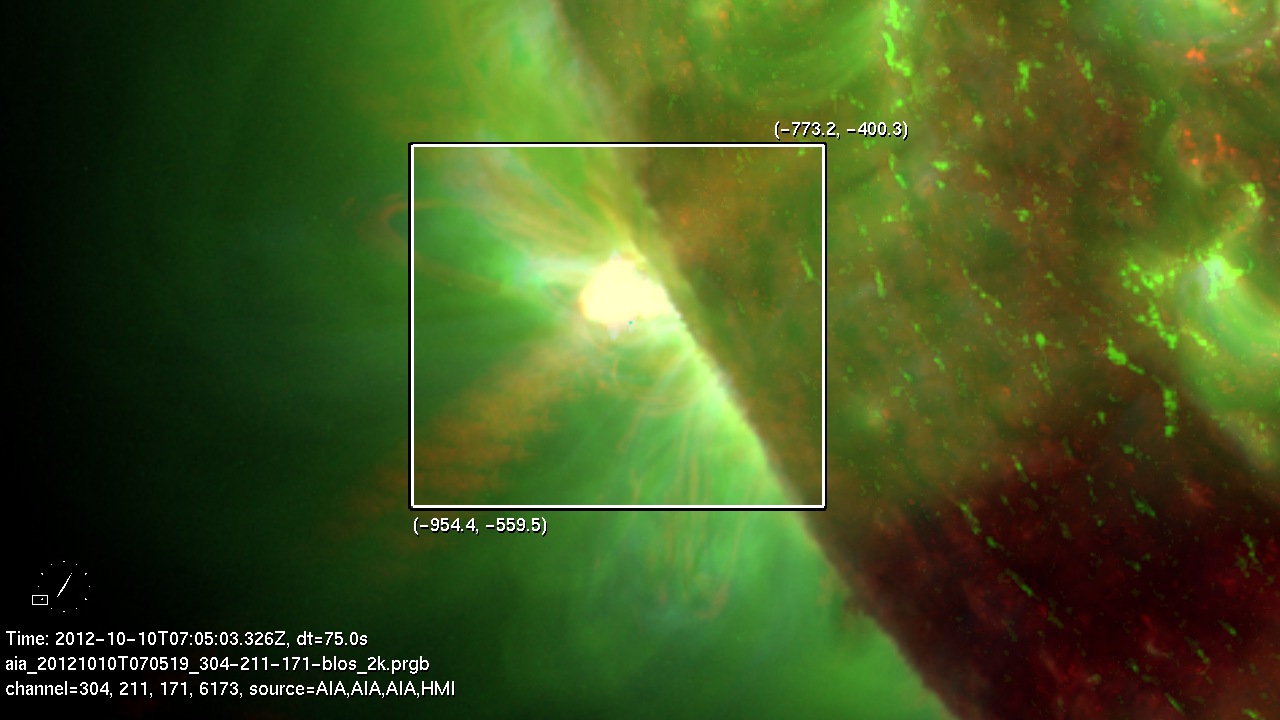
The following attributes suggest an emerging flux region just behind the limb: 1. Very dynamic loops structures, 2. Frequent surges (optically thick material) in the foreground of the EUV loops, and 3. A localized brightening, possibly due to reconnection event(s). Surges are commonly found in the periphery of emerging flux regions as the emerging magnetic field impinges on pre-existing neighbouring field. The squeezing of the field could squirt dense material into a surge.

Rating:
3.0 (0=lowest, 5=highest)
Num Ratings:1
Detected by cheung, Submitted at 2014-02-10T02:14:15
2012-02-04T19:00:04 --> 2012-02-06T03:00:04
Typical of a coronal cavity observed with AIA, there is a quiescent filament sitting underneath.
Rating:
3.0 (0=lowest, 5=highest)
Num Ratings:1
Detected by cheung, Submitted at 2014-02-10T02:14:14
2012-04-07T12:00:04 --> 2012-04-09T00:00:04
Coronal cavity with long, vertical strands of filamentary materia beneath it.

Rating:
3.0 (0=lowest, 5=highest)
Num Ratings:1
Detected by anny, Submitted at 2014-02-05T02:26:24
2014-01-30T13:14:03 --> 2014-01-30T17:18:03
The Earth transit has clearly caused the large filament to erupt producing an EUV wave. The preceding M6.6 flare is purely coincidental.


Rating:
3.0 (0=lowest, 5=highest)
Num Ratings:1
Detected by halocme, Submitted at 2014-02-03T15:38:20
2014-01-30T21:00:35 --> 2014-02-03T03:00:35
From 31 Jan through 2 Feb, the visible side of the Sun showed a big active region AR 1967 in the souther hemisphere coming toward central meridian. In addition, another region AR 1968 was seen in the norther hemisphere. Together there were 10 M-class flares. Every time an intense flare occurred in one of these regions, space weather fans wishfully thought they would launch a CME that could affect the heliosphere. This seemed to be all wrong, however. It is true that a CME can be harder to see if it arises from a region close to disk center, but the appearance of the associated coronal dimming indicates that the flares from AR 1967 or 1968 were not associated with major CMEs. Perhaps these regions were embedded in strong magnetic field environment. The trans-equatorial loops between them also seemed to be quite stable. During this period CMEs were mostly from backside regions occasionally producing clear dimming over the southwest limb and marginal dimming over the east limb. The CME source identification has been done using STEREO data.

Rating:
3.0 (0=lowest, 5=highest)
Num Ratings:1
Detected by anny, Submitted at 2014-02-01T02:51:10
2014-01-27T17:24:03 --> 2014-01-27T23:42:03
A sequence of rapid surges at the W limb.

Rating:
3.0 (0=lowest, 5=highest)
Num Ratings:1
Detected by anny, Submitted at 2014-02-01T02:49:30
2014-01-27T10:33:03 --> 2014-01-27T17:51:03
A large short-lived prominence, perhaps a part of the filament at the top of the selected ROI.
