
Highest Rated Events (only 193 and 304 shown) All AR FE FL

Rating:
3.0 (0=lowest, 5=highest)
Num Ratings:1
Detected by halocme, Submitted at 2017-08-28T00:25:51
2017-08-19T21:10:13 --> 2017-08-19T22:51:01
The flare in AR 12671 seemed to be triggered by a filament eruption toward north. The wave front formed as a result of the eruption and was limited to the northern direction.


Rating:
3.0 (0=lowest, 5=highest)
Num Ratings:1
Detected by gchintzo, Submitted at 2017-08-22T19:22:59
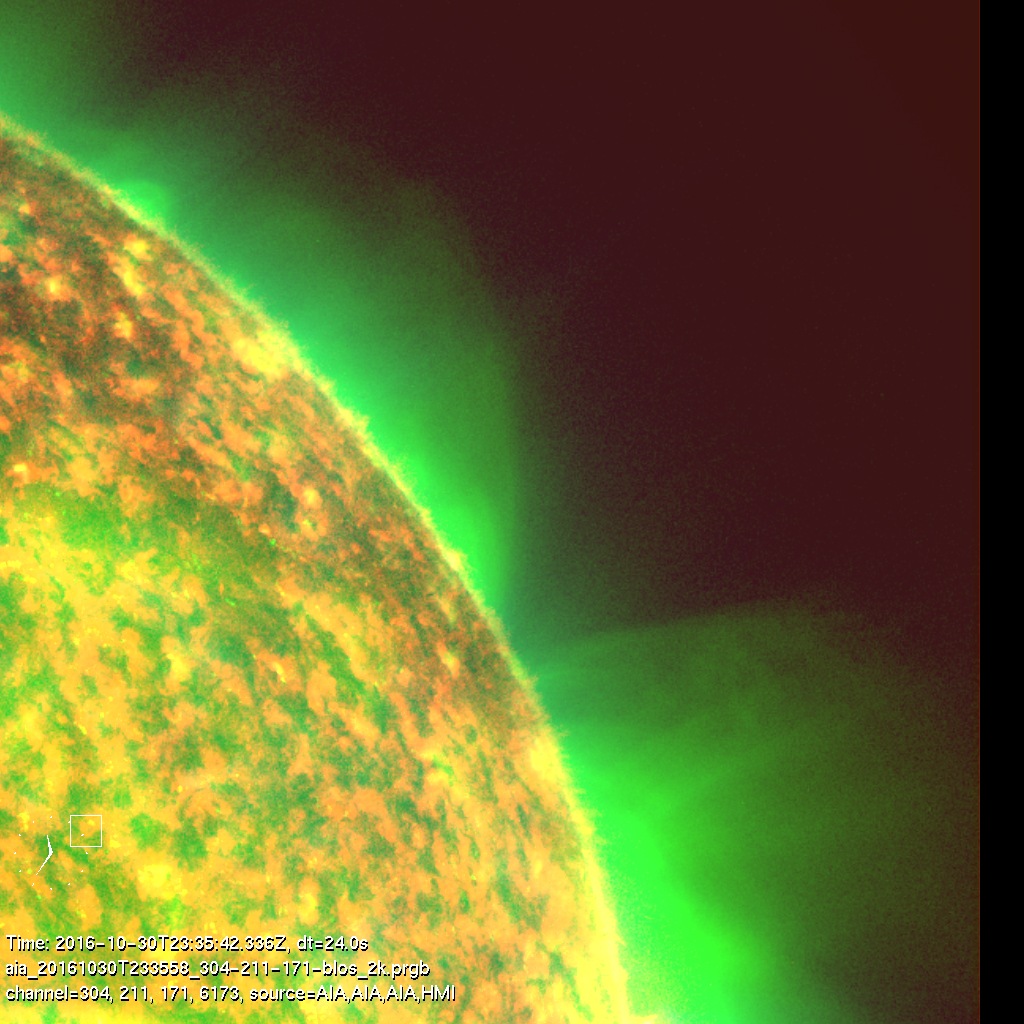
2016-10-30T23:10:54 --> 2016-10-31T00:27:54
The initial stage of a CME seen in LASCO on 2016/10/31 00:24 (http://spaceweather.gmu.edu/seeds/mkmovie.php?cme=20161031.002406.w069.v0233.p286&frame=11&r). The source AR is behind the solar limb. Oscillations are seen in the ambient corona after the eruption.

Rating:
3.0 (0=lowest, 5=highest)
Num Ratings:1
Detected by gchintzo, Submitted at 2017-08-22T19:22:57
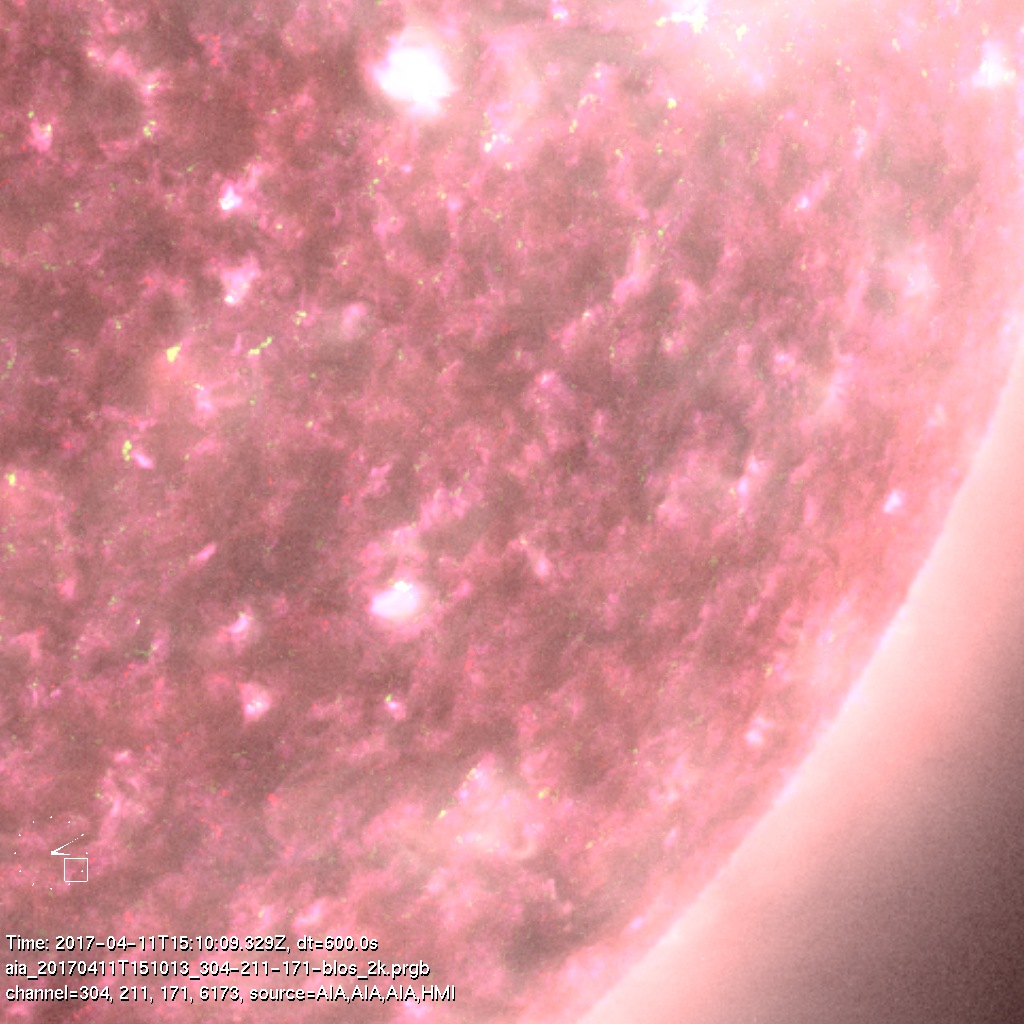
2017-04-11T07:20:09 --> 2017-04-11T20:10:09
A filament in the quiet sun activates, lifts and causes a bubble-like shape around it in the 2MK Corona (211 Angstroem channel of AIA). Some very remote brightenings seem to follow this failed eruption.

Rating:
3.0 (0=lowest, 5=highest)
Num Ratings:1
Detected by gchintzo, Submitted at 2017-08-22T19:22:54
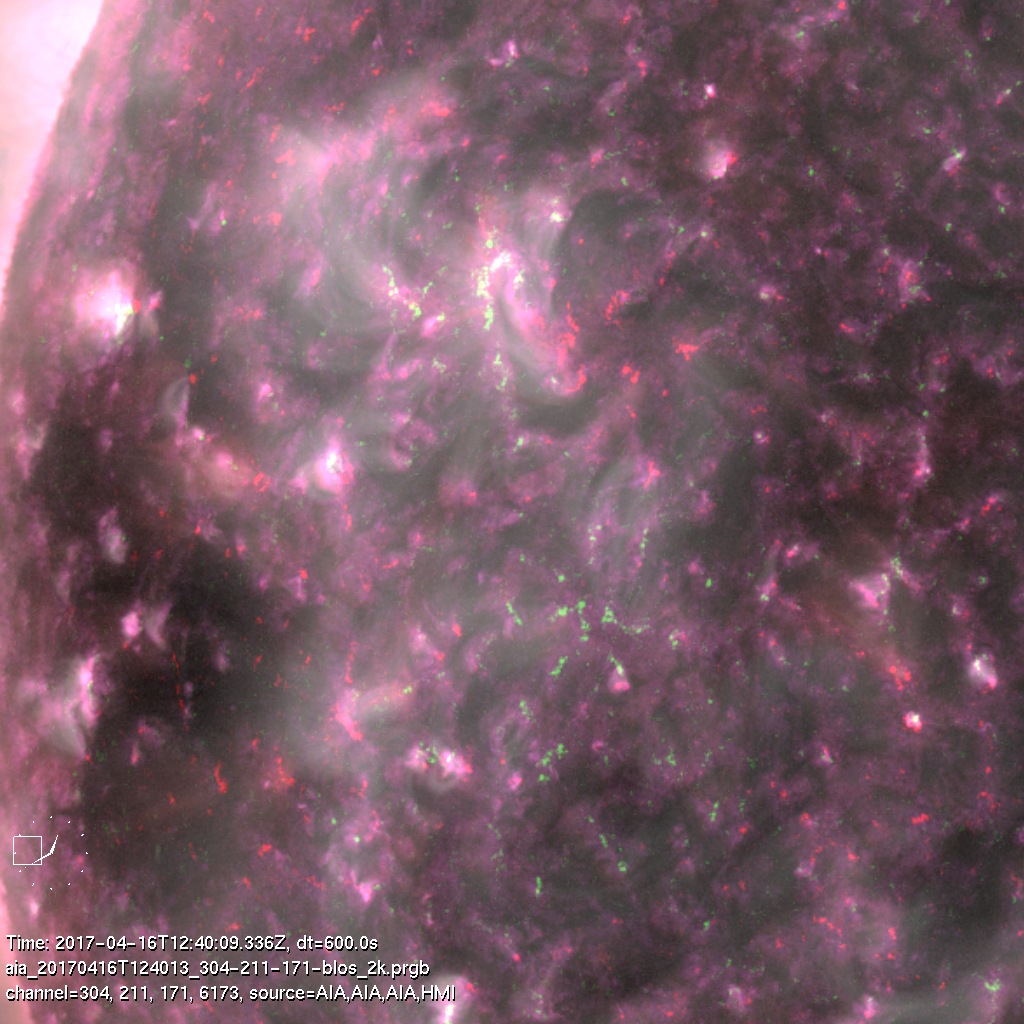
2017-04-16T02:30:09 --> 2017-04-18T00:00:09
A small coronal hole spanning above and below the solar equator

Rating:
3.0 (0=lowest, 5=highest)
Num Ratings:1
Detected by halocme, Submitted at 2017-08-20T22:58:10
2017-08-03T09:25:13 --> 2017-08-03T10:35:13
The eruption is so diffuse that one can hardly see it in intensity images. Difference images show it more clearly. A brightening suggests that the one leg of the erupting structure was on the visible side.


Rating:
3.0 (0=lowest, 5=highest)
Num Ratings:1
Detected by halocme, Submitted at 2017-08-20T22:52:15
2017-08-03T09:00:09 --> 2017-08-03T10:00:09
Disturbances that first started as a jet-like ejection are seen as waves that affect the large-scale corona.


Rating:
3.0 (0=lowest, 5=highest)
Num Ratings:1
Detected by halocme, Submitted at 2017-08-20T22:43:17
2017-08-01T23:00:09 --> 2017-08-02T02:16:09
This event took a usual step of slow rising motions before the eruption. The background corona does not seem to be largely affected. Its associated CME is narrow (http://spaceweather.gmu.edu/seeds/mkmovie_ql.php?cme=20170802.004807.w041.v0232.p053&frame=17).

Rating:
3.0 (0=lowest, 5=highest)
Num Ratings:1
Detected by halocme, Submitted at 2017-08-20T22:31:26
2017-07-30T09:00:09 --> 2017-07-30T10:09:45
This gives an impression that some small structure outside ARs somehow got unstable and erupted. No CME resulted.


Rating:
3.0 (0=lowest, 5=highest)
Num Ratings:1
Detected by halocme, Submitted at 2017-08-20T22:21:31
2017-08-01T00:00:09 --> 2017-08-14T12:00:09
In the previous rotation, this region was AR 12665 and responsible for several noteworthy eruptions including the Bastille Day 2017 event. On the backside it produced an eruption, seen as a bright symmetric halo CME, which was arguably as intense as the Carrington event. However, the region has done nothing of note since then, not even flares. This movie of its disk passage essentially shows no major changes in the photospheric magnetic field and hence the overlying coronal structure for two weeks.

Rating:
3.0 (0=lowest, 5=highest)
Num Ratings:1
Detected by gchintzo, Submitted at 2017-08-18T20:49:24
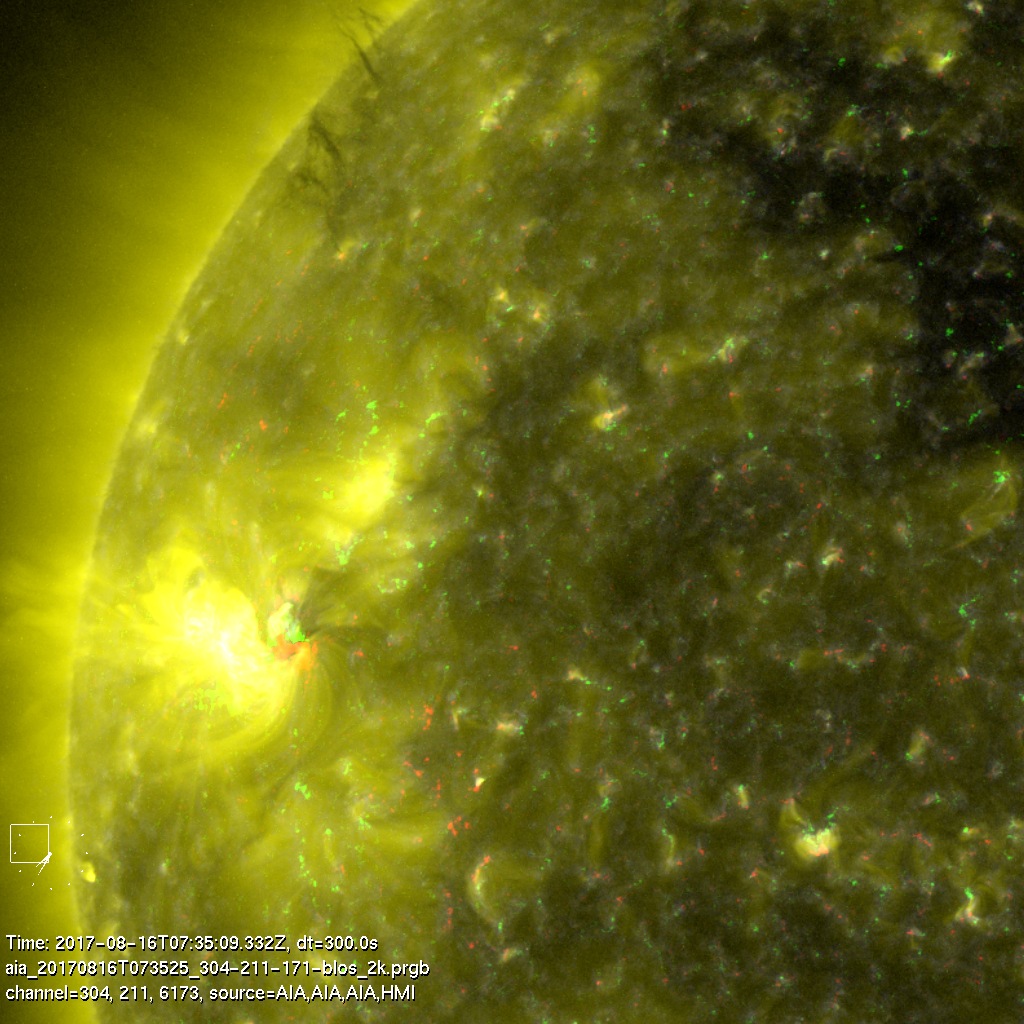
2017-08-16T06:30:09 --> 2017-08-16T11:30:09
Source AR12671 undergoes confined flaring (no CME signatures in LASCO coronagraphs) and launches a (faint) coronal wave towards the coronal hole. Hints of reflection off the coronal hole boundaries are visible.
Rating:
3.0 (0=lowest, 5=highest)
Num Ratings:1
Detected by gchintzo, Submitted at 2017-08-18T20:13:07
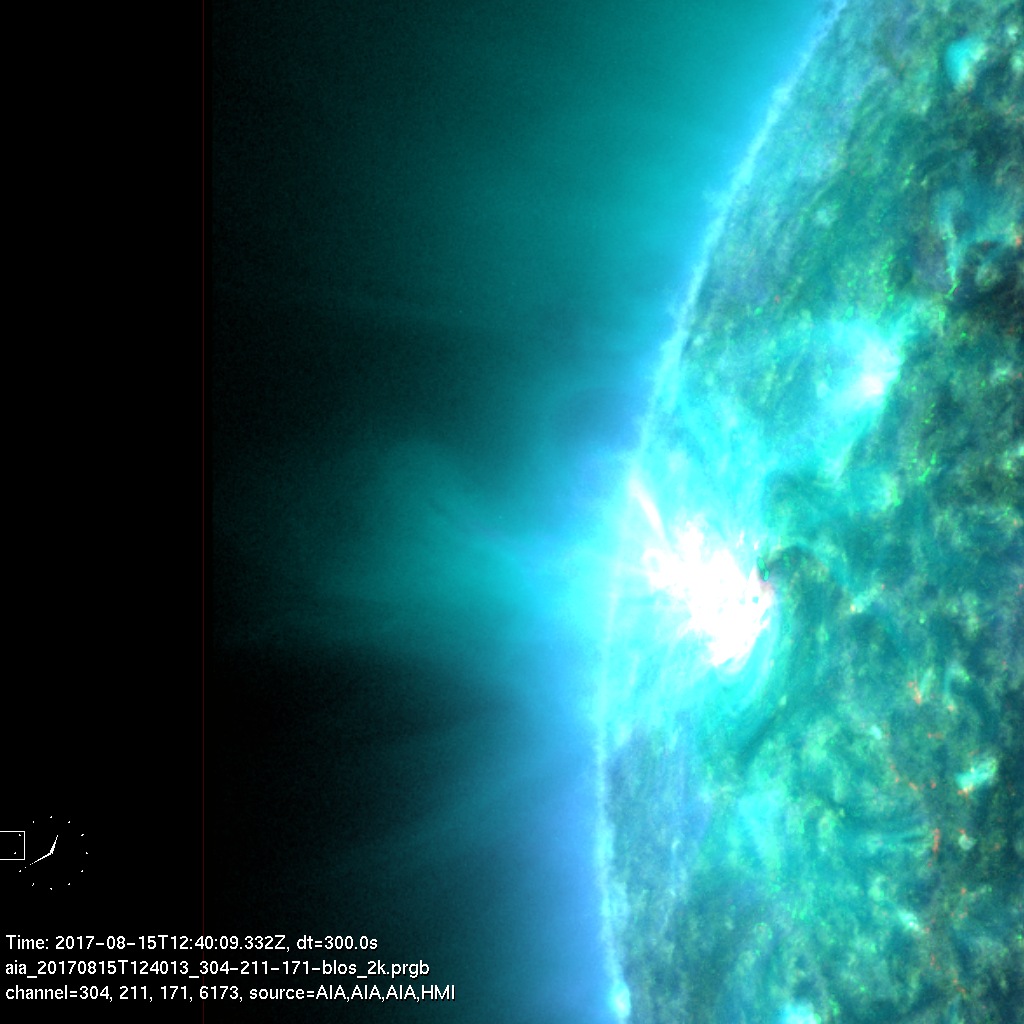
2017-08-15T08:30:09 --> 2017-08-15T19:20:09
NOAA AR 12671 was the source of a slow CME (~170 km s-1; http://spaceweather.gmu.edu/seeds/mkmovie_ql.php?cme=20170815.122408.w071.v0163.p087&frame=19).
Rating:
3.0 (0=lowest, 5=highest)
Num Ratings:1
Detected by gchintzo, Submitted at 2017-08-18T18:45:07
2017-08-17T12:30:09 --> 2017-08-17T17:20:09
A second CME eruption ~2 hours after the first one, originating from the back side of the sun (i.e. source region still behind the visible hemisphere).

Rating:
3.0 (0=lowest, 5=highest)
Num Ratings:1
Detected by gchintzo, Submitted at 2017-08-18T18:27:42
2017-08-16T23:00:09 --> 2017-08-17T12:00:09
A low coronal signature of a CME "bubble" seen at the east limb. The source region is yet to be brought into view by the rotation of the sun.

Rating:
3.0 (0=lowest, 5=highest)
Num Ratings:1
Detected by gchintzo, Submitted at 2017-08-18T18:18:39
2017-08-16T23:00:09 --> 2017-08-18T04:30:09
A solar prominence (i.e. a filament seen at the solar limb) rises and eventually erupts. There is a possibility for a CME event for this eruption.

Rating:
3.0 (0=lowest, 5=highest)
Num Ratings:1
Detected by gchintzo, Submitted at 2017-08-18T18:05:52
2017-08-15T07:10:09 --> 2017-08-16T05:30:09
A large coronal hole extending from the north pole towards mid latitudes. Note the predominantly unipolar field distribution (green color)

Rating:
3.0 (0=lowest, 5=highest)
Num Ratings:1
Detected by gchintzo, Submitted at 2017-08-14T18:00:00
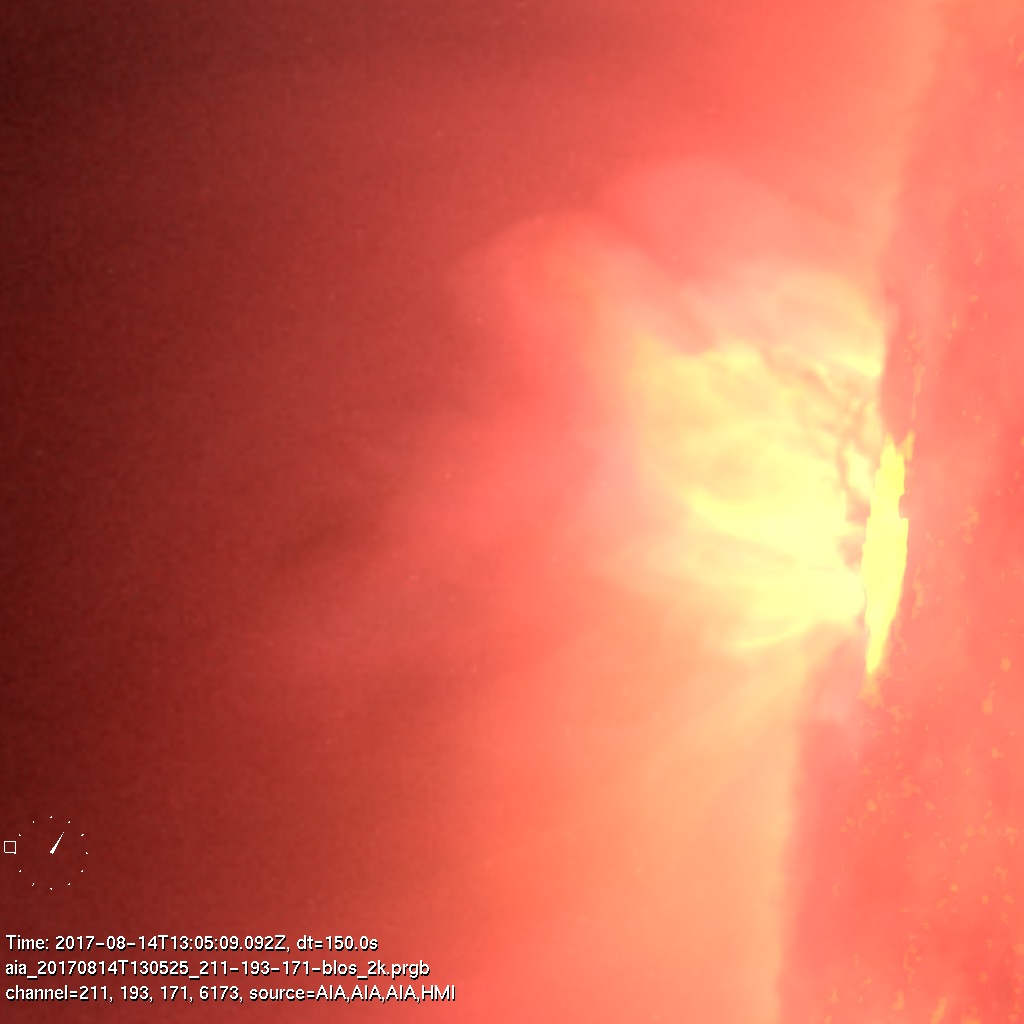
2017-08-13T21:20:09 --> 2017-08-14T13:20:09
Three consecutive eruptions spaced apart by ~2 hours each in an AR that the solar rotation brings it to the visible hemisphere of the sun. It is not clear whether these eruptions were CMEs (lack of real time data at the time of this event annotation).
Rating:
3.0 (0=lowest, 5=highest)
Num Ratings:1
Detected by gchintzo, Submitted at 2017-08-14T17:45:30
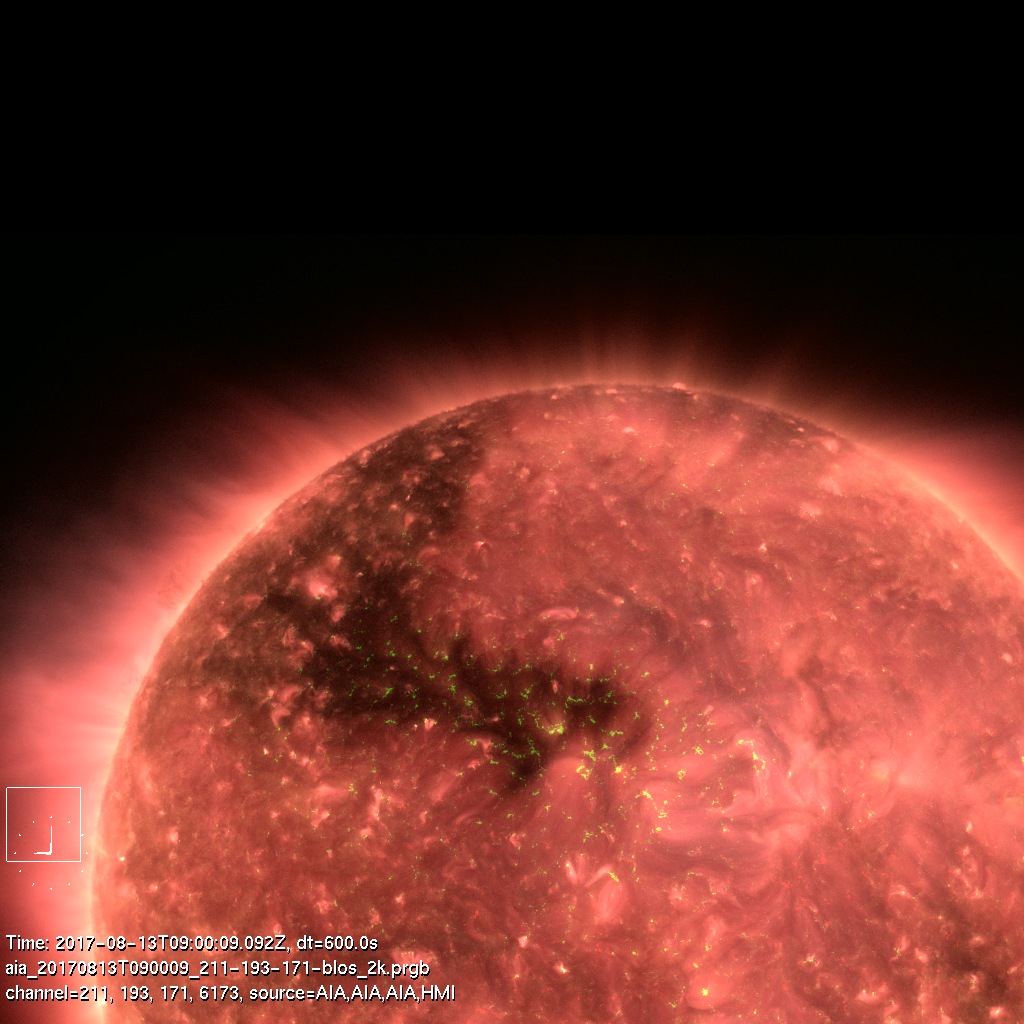
2017-08-12T14:10:09 --> 2017-08-14T13:20:09
A coronal hole of predominantly positive polarity that seems to extend all the way to the pole; effectively making it an extension of the polar coronal hole. The spread of the coronal hole suggests that it is created by the decay of the trailing polarity of an active region.
Rating:
3.0 (0=lowest, 5=highest)
Num Ratings:1
Detected by gchintzo, Submitted at 2017-08-14T17:33:02
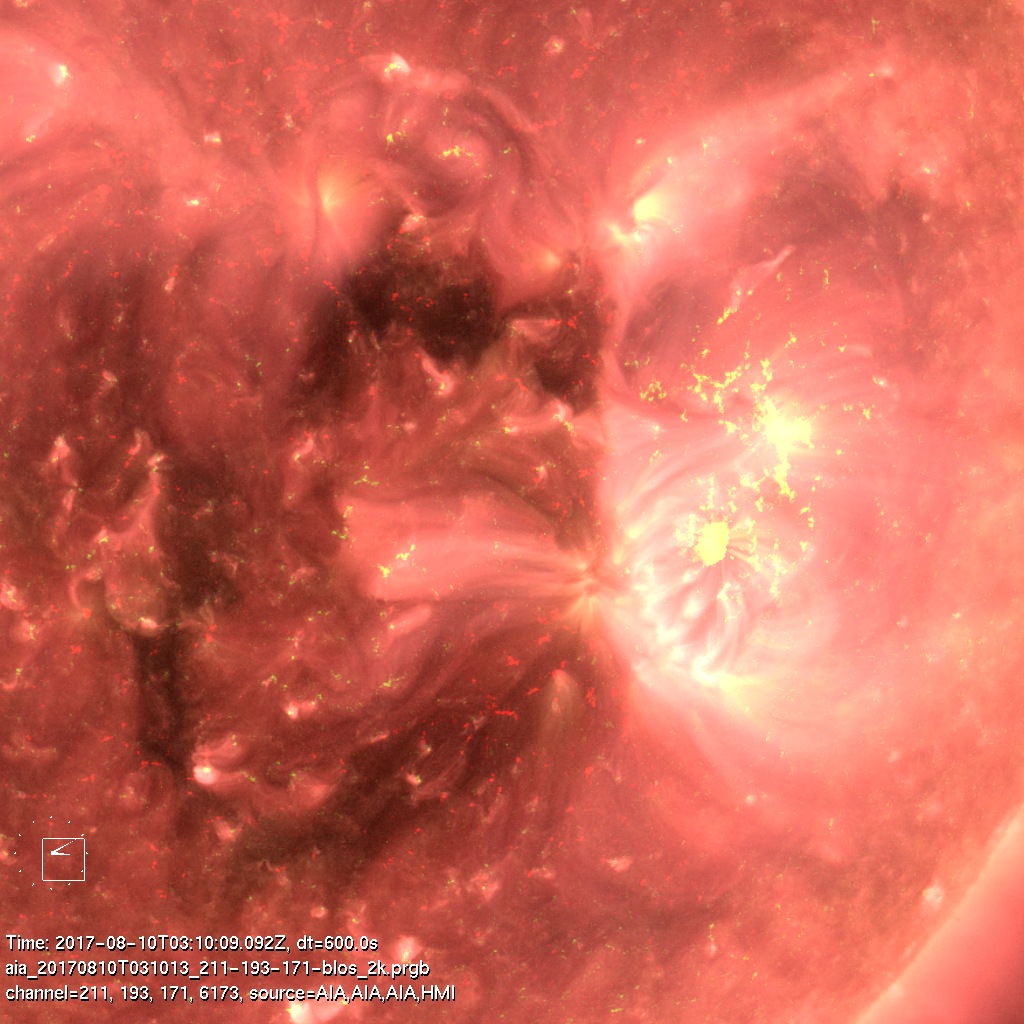
2017-08-10T00:00:09 --> 2017-08-11T09:50:09
A large coronal hole of predominantly negative polarity (red magnetic field contours). This coronal hole seems to be disrupted by some positive polarity elements (green) in the middle of its area - this makes the field lines to close with nearby negative patches (pink composite of 211A, 193A and 171A channel) and thus disrupt its area of open field lines.

Rating:
3.0 (0=lowest, 5=highest)
Num Ratings:1
Detected by halocme, Submitted at 2017-07-31T17:25:53
2017-06-21T00:00:09 --> 2017-06-22T14:00:09
This is one of the big objects that used to be called bright points. They indicate flux emergence in polar regions, although it is difficult to observe the magnetic field there.

Rating:
3.0 (0=lowest, 5=highest)
Num Ratings:1
Detected by halocme, Submitted at 2017-07-31T16:58:25
2017-06-20T04:40:13 --> 2017-06-20T08:29:25
The eruption starts with coronal dimming to the north of the active region, followed by the formation of post-eruption loops around it. The associated CME indicates a flux rope (http://spaceweather.gmu.edu/seeds/mkmovie_ql.php?cme=20170620.063607.w040.v0323.p063&frame=10).
